
Systematic vs Unsystematic Risk: How Diversification Reduces Both
Systematic vs Unsystematic Risk: How Diversification Reduces Both
Investing in equity markets offers opportunities for long-term wealth creation, but it also involves exposure to different types of investment risk in the stock market. Understanding how these risks operate is an important step toward building a resilient portfolio.
One of the most commonly discussed concepts in finance is systematic vs unsystematic risk. These two categories explain why some risks affect the entire market while others are limited to specific companies or sectors. More importantly, they highlight why diversification in portfolio management is often considered a fundamental strategy for managing risk.
For retail investors in India who are building long-term portfolios, understanding these risks can help in making more structured investment decisions.
Understanding Investment Risk in the Stock Market
In simple terms, investment risk refers to the possibility that actual returns may differ from expected returns. Market prices fluctuate due to economic developments, company performance, geopolitical events, and investor sentiment.
Broadly, investment risks in equities can be classified into two categories:
- Systematic risk
- Unsystematic risk
This classification forms the basis of the systematic risk vs market risk discussion commonly found in portfolio management frameworks.
What Is Systematic Risk?
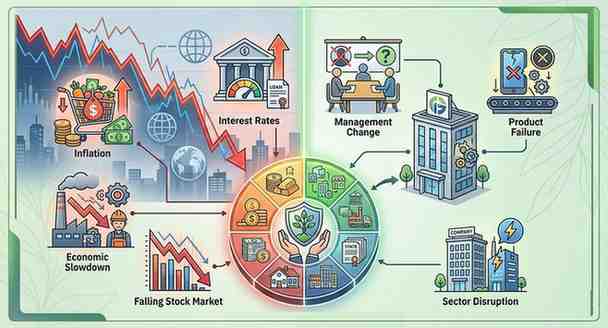
Systematic risk, often referred to as market risk, represents the risk that affects the entire financial market or a large segment of it. These risks arise from macroeconomic factors that influence almost all companies and industries.
Because systematic risk is driven by broad economic forces, it cannot be completely eliminated through diversification.
Common Sources of Systematic Risk
Several factors can create systematic risk in equity markets:
- Interest Rate Changes
When central banks adjust interest rates, borrowing costs for businesses and consumers change, which can influence corporate profitability and equity valuations. - Inflation Trends
Higher inflation can erode purchasing power and compress profit margins, affecting companies across sectors. - Economic Slowdowns
Economic contractions or reduced growth can lead to lower corporate earnings and market volatility. - Geopolitical Developments
Global conflicts, trade disputes, and political uncertainty can affect investor sentiment and capital flows. - Policy and Regulatory Changes
Government fiscal policies, taxation rules, and sector regulations can influence market performance.
These risks illustrate why systematic risk vs market risk is often used interchangeably in financial literature.
What Is Unsystematic Risk?
While systematic risk affects the entire market, unsystematic risk is specific to individual companies or industries.
This type of risk arises from internal factors such as management decisions, operational issues, competitive dynamics, or sector-specific developments.
Unlike systematic risk, unsystematic risk can be significantly reduced through diversification.
Unsystematic Risk Examples in Investing
Understanding unsystematic risk examples in investing can help investors see how company-level issues affect stock prices.
Some common examples include:
- Management Changes
Leadership transitions or governance issues can influence company performance. - Product Failures
A failed product launch or recall can negatively impact a company’s revenue outlook. - Industry Disruptions
Technological changes or new entrants may affect specific industries. - Supply Chain Disruptions
Operational issues such as raw material shortages may affect individual companies. - Corporate Debt Issues
High leverage or liquidity constraints can increase financial risk for a company.
Because these risks are company-specific, holding a diversified basket of stocks can reduce their impact on a portfolio.
Systematic vs Unsystematic Risk: Key Differences
Understanding the differences between systematic vs unsystematic risk helps investors evaluate how various risks influence portfolio outcomes.
| Feature | Systematic Risk | Unsystematic Risk |
| Scope | Affects the entire market | Affects individual companies or sectors |
| Source | Macroeconomic factors | Company-specific factors |
| Diversification impact | Cannot be eliminated | Can be reduced through diversification |
| Examples | Inflation, interest rates, economic slowdown | Management issues, product failures |
| Also known as | Market risk | Specific risk |
This distinction is central to modern portfolio construction frameworks.
Role of Diversification in Portfolio Management
One of the most widely discussed strategies for managing investment risk is diversification in portfolio management. Diversification involves spreading investments across different assets, sectors, or geographies to reduce exposure to individual risks.
How Diversification Reduces Unsystematic Risk
Diversification works particularly well in addressing company-specific risks.
For example:
- If one company in a portfolio faces operational issues, the impact may be offset by the performance of other companies.
- Holding stocks across multiple sectors reduces exposure to industry-specific disruptions.
- Investing in diversified mutual funds or index funds spreads risk across many securities.
In theory, as the number of securities in a portfolio increases, unsystematic risk tends to decline.
Why Diversification Cannot Remove Systematic Risk
Even a diversified portfolio cannot completely eliminate systematic risk.
For instance:
- A broad market correction may affect most equities simultaneously.
- Interest rate hikes may influence valuations across sectors.
- Economic slowdowns can reduce earnings expectations for many companies.
This is why systematic risk remains a structural component of equity investing.
Practical Diversification Strategies for Retail Investors
For retail investors, diversification does not necessarily require a complex portfolio. Several practical approaches can help manage risk effectively.
- Sector Diversification
Allocating investments across sectors such as banking, technology, pharmaceuticals, and consumer goods can reduce concentration risk.
- Market Capitalisation Diversification
Combining large-cap, mid-cap, and small-cap stocks may provide exposure to different growth dynamics.
- Asset Class Diversification
A portfolio that includes equities, debt instruments, and gold can help balance risk and return.
- Geographic Diversification
Exposure to international markets can reduce reliance on a single economy.
- Use of Diversified Funds
Mutual funds or exchange-traded funds may provide built-in diversification for investors who prefer a simplified approach.
These strategies align with broader frameworks of diversification in portfolio management commonly used by institutional and retail investors alike.
Why Understanding Risk Matters for Long-Term Investors
Many new investors focus primarily on potential returns. However, understanding types of investment risk in the stock market can help build more sustainable investment strategies.
A structured understanding of systematic vs unsystematic risk allows investors to:
- Design more balanced portfolios
- Avoid excessive concentration in a single stock or sector
- Align investment strategies with long-term goals
- Manage volatility expectations during market cycles
Risk awareness also helps investors maintain discipline during periods of market uncertainty.
Conclusion
The distinction between systematic vs unsystematic risk provides a useful framework for understanding how different forces influence equity market performance. Systematic risk arises from broad economic factors that affect the entire market, while unsystematic risk originates from company-specific developments.
Although systematic risk cannot be completely eliminated, diversification in portfolio management can significantly reduce exposure to unsystematic risk by spreading investments across multiple assets and sectors. For retail investors in India, incorporating diversification into portfolio construction may help manage volatility and support more balanced long-term investment outcomes.
As with any investment decision, investors should evaluate their financial goals, risk tolerance, and investment horizon before allocating capital to equity markets.
Sources and Official References
Association of Mutual Funds in India
Institute of Chartered Accountants of India (ICAI) – Auditing Standards
Related Blogs:
Build a Stronger Investment Portfolio Through Diversification
Different Types of Commodities and Their Trading Characteristics
Beyond Stocks: Exploring the World of Commodities
Diversification Strategies: Combining Commodities and Equities
How to Use Sector Rotation to Diversify Your Portfolio
Commodity vs Equity Market: A Beginner’s Guide to Understanding the Differences
Understanding Asset Classes: A Beginner’s Guide to Stocks, Bonds, and Alternatives
Diversification Strategies: Why Spreading Your Risk Matters
How to Build an All-Weather Portfolio?
Disclaimer: This blog post is intended for informational purposes only and should not be considered financial advice. The financial data presented is subject to change over time, and the securities mentioned are examples only and do not constitute investment recommendations. Always conduct thorough research and consult with a qualified financial advisor before making any investment decisions.
What is the difference between systematic and unsystematic risk?
Systematic risk refers to market-wide risks caused by macroeconomic factors such as inflation, interest rate changes, or economic slowdowns. Unsystematic risk, on the other hand, is company- or sector-specific and arises from factors such as management decisions, operational issues, or industry disruptions.
Can diversification eliminate systematic risk?
Diversification helps reduce company-specific or unsystematic risk, but it cannot completely eliminate systematic risk because market-wide events affect most securities simultaneously.
What are some examples of unsystematic risk in investing?
Examples include management changes, product failures, regulatory issues affecting a specific company, supply chain disruptions, or financial stress within an individual firm.
Why is diversification important in portfolio management?
Diversification spreads investments across different companies, sectors, and asset classes, which helps reduce the impact of unsystematic risks on an overall portfolio.
How can retail investors diversify their portfolios?
Retail investors can diversify by investing across sectors, market capitalisations, and asset classes such as equities, debt instruments, and gold, or by using diversified mutual funds or index funds.