
Cost, Risk, and Return: How to Evaluate Portfolio Management Styles
Cost, Risk, and Return: How to Evaluate Portfolio Management Styles
What Are the Three Pillars of Portfolio Evaluation?
When evaluating an investment strategy in India, analysts typically focus on:
- Cost – What you pay to own the investment
- Risk – How much volatility and downside exposure exists
- Return – The potential and consistency of gains
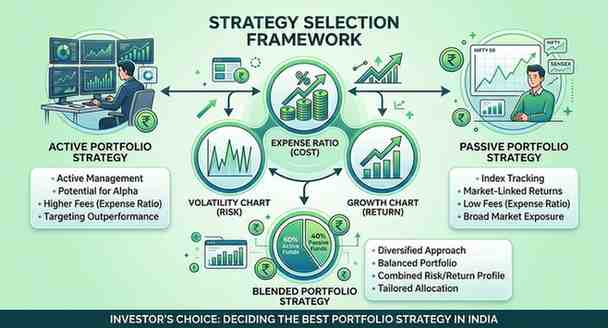
Each pillar influences long-term wealth creation and should be assessed together. Choosing between active, passive, or blended portfolio strategies requires evaluating three core factors: cost, risk, and return. For Indian investors, understanding how expense ratios, volatility, and risk-adjusted performance interact can significantly improve long-term outcomes. A structured evaluation framework helps investors move beyond short-term returns and make more informed allocation decisions.
Why Does Expense Ratio Matter in Mutual Funds?
The expense ratio is one of the most measurable costs in mutual fund investing. Over long holding periods, even small fee differences can meaningfully affect outcomes due to compounding.
Key Effects of Higher Costs
- Reduces net returns every year
- Impact compounds over long-term SIPs
- Makes it harder for active funds to outperform benchmarks
- Particularly important for long-term retirement portfolios
Example :
If two equity funds deliver 12% gross returns but one charges 2% and the other 0.5%, the lower-cost fund can create significantly higher corpus value over 15–20 years.
According to data published by Association of Mutual Funds in India (AMFI), cost efficiency is a key differentiator in long-term fund performance.
How Does the Risk–Return Tradeoff Work?
The risk–return tradeoff suggests that investments offering higher potential returns usually involve higher volatility and downside risk.
Important Risk Indicators
Investors in India commonly evaluate:
- Standard deviation
- Maximum drawdown
- Sharpe ratio
- Portfolio concentration
- Sector exposure
- Beta vs benchmark
Risk should always be reviewed across full market cycles, not just recent performance.
Key Portfolio Evaluation Metrics Every Investor Should Check
- Expense Ratio
Indicates the annual cost of managing the fund.
- Sharpe Ratio
Measures return generated per unit of risk.
- Alpha
Shows excess return over the benchmark (important for active funds).
- Beta
Measures sensitivity to market movements like NIFTY 50 or BSE Sensex.
- Tracking Error
Critical for passive funds; shows how closely the fund follows its index.
Active vs Passive vs Hybrid: Cost–Risk–Return Comparison
| Feature | Active Funds | Passive Funds | Hybrid Funds |
| Management Style | Fund manager actively selects stocks | Tracks an index like NIFTY 50 or Sensex | Mix of equity and debt managed actively |
| Typical Expense Ratio | Higher (often 1–2.25%) | Lower (often 0.05–0.5%) | Moderate (varies by allocation) |
| Return Potential | Can outperform benchmark (not guaranteed) | Matches index performance | Balanced, moderate return potential |
| Risk Level | Depends on fund strategy; can be high | Mirrors market risk | Usually lower than pure equity |
| Consistency | Depends on fund manager skill | Highly consistent with index | More stable than pure equity |
| Best Suited For | Investors seeking alpha and willing to take risk | Cost-conscious, long-term investors | Investors wanting balanced exposure |
| Tracking Error | Not applicable | Important metric | Not primary focus |
| Behavioural Comfort | Requires patience during underperformance | Easier to stay invested | Comfortable for moderate-risk investors |
Quick Insight:
- Choose active funds if you seek potential outperformance and accept manager risk.
- Choose passive funds if you prioritise low cost and market-linked returns.
- Choose hybrid funds if you want a balance between growth and stability.
How Does Investment Horizon Affect Portfolio Evaluation?
Time horizon plays a major role in evaluating investment strategies in India.
Short-Term Investors Usually Focus On
- Volatility control
- Liquidity
- Tactical allocation
- Drawdown protection
Long-Term Investors Typically Prioritise
- Cost efficiency
- Consistency across cycles
- Risk-adjusted returns
- Power of compounding through SIPs
What Behavioural Mistakes Should Investors Avoid?
Even well-designed portfolios can underperform due to behavioural biases.
Common Investor Mistakes
- Chasing recent top-performing funds
- Panic selling during market corrections
- Ignoring expense ratios
- Overtrading or frequent switching
- Not aligning investments with goals
A disciplined review framework helps reduce these risks.
How Can Investors Build a Balanced Evaluation Framework?
Investors conducting portfolio cost–risk–return analysis in India should consider:
- Aligning strategy with financial goals
- Reviewing performance across full market cycles
- Comparing funds within the same category
- Monitoring expense ratios periodically
- Maintaining diversification across asset classes
- Checking fund data from SEBI-registered sources
Regulatory note: Mutual funds in India are regulated by the Securities and Exchange Board of India, and investors should verify scheme details through official disclosures.
Conclusion
A disciplined approach to portfolio evaluation helps investors move beyond headline returns and focus on sustainable wealth creation. Understanding cost structures, the risk–return relationship, and behavioural factors can improve long-term decision-making.
Investment choices should always reflect individual financial goals, time horizon, and risk tolerance rather than short-term performance rankings.
Sources and Official References
Association of Mutual Funds in India
Institute of Chartered Accountants of India (ICAI) – Auditing Standards
Related Blogs:
Build a Stronger Investment Portfolio Through Diversification
Different Types of Commodities and Their Trading Characteristics
Beyond Stocks: Exploring the World of Commodities
Diversification Strategies: Combining Commodities and Equities
How to Use Sector Rotation to Diversify Your Portfolio
Commodity vs Equity Market: A Beginner’s Guide to Understanding the Differences
Understanding Asset Classes: A Beginner’s Guide to Stocks, Bonds, and Alternatives
Diversification Strategies: Why Spreading Your Risk Matters
How to Build an All-Weather Portfolio?
Disclaimer: This blog post is intended for informational purposes only and should not be considered financial advice. The financial data presented is subject to change over time, and the securities mentioned are examples only and do not constitute investment recommendations. Always conduct thorough research and consult with a qualified financial advisor before making any investment decisions.
Why is expense ratio important in mutual funds?
It directly reduces your net returns every year and compounds over long holding periods.
What is the risk–return tradeoff in mutual funds?
Higher potential returns typically come with higher volatility and downside risk.
Where can Indian investors check mutual fund risk metrics?
Investors can review risk ratios and disclosures on AMFI, fund house websites, and SEBI filings.
How often should investors review their portfolio?
Most experts suggest reviewing portfolios at least once or twice a year, or after major life or market changes.