
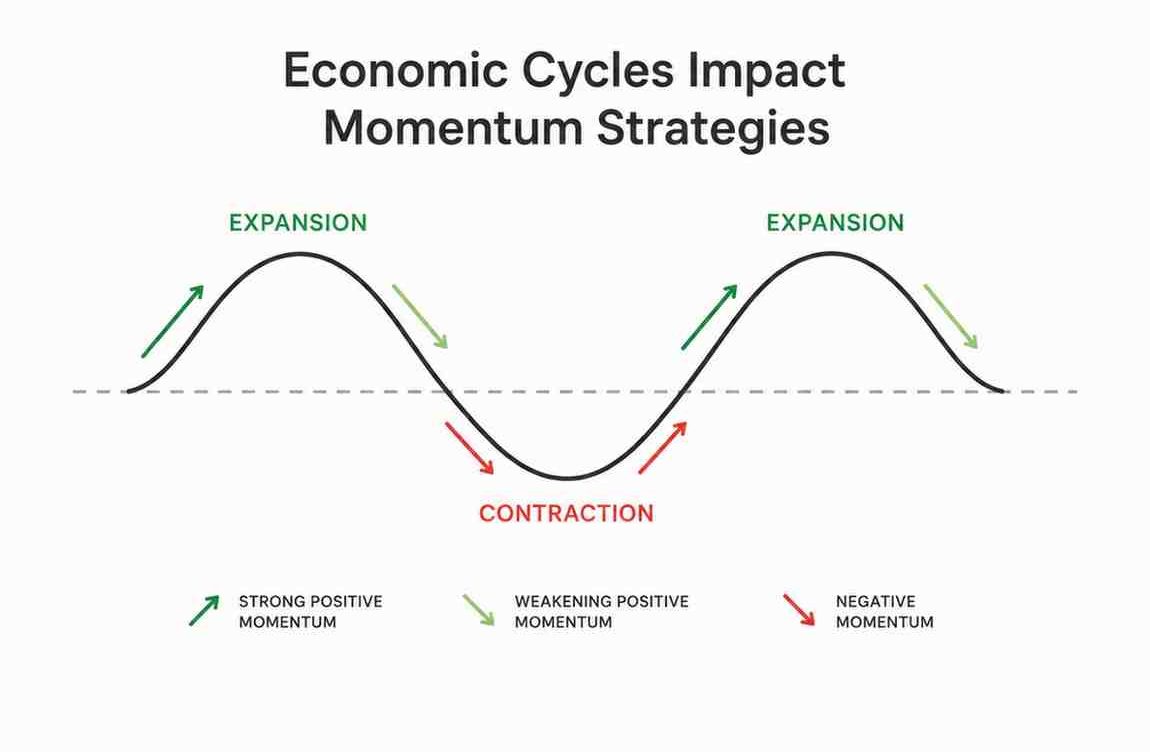
How Indian Economic Cycles Impact Momentum Strategies
How Indian Economic Cycles Impact Momentum Strategies
India’s stock market does not operate independently from the broader economy. Economic growth trends, inflation levels, RBI policy decisions, corporate earnings, and investor sentiment collectively influence market direction over time. These recurring phases of expansion, slowdown, contraction, and recovery are commonly known as economic cycles.
For investors exploring momentum investing strategies in India, understanding economic cycles is important because momentum-based investing often reacts differently during changing market conditions. Certain sectors may outperform during periods of economic growth, while others may gain traction during slowdowns or volatile phases.
This article explains the connection between the Indian economic cycle and momentum investing, how sector leadership changes across market phases, and what retail investors should understand before evaluating momentum-focused mutual funds or investment strategies.
What Are Economic Cycles in India?
Economic cycles refer to fluctuations in economic activity over a period of time. In India, these cycles are influenced by several domestic and global factors, including:
- RBI monetary policy changes
- Inflation and interest rate movements
- Government spending and reforms
- Corporate earnings growth
- Global commodity prices
- Consumer demand and spending
- Foreign institutional investor (FII) flows
Typically, economic cycles move through four broad phases:
| Economic Phase | Market Environment | Common Investor Behaviour |
| Expansion | Rising GDP growth and improving earnings | Higher participation in equities |
| Peak | Elevated valuations and inflation concerns | Profit booking and cautious investing |
| Slowdown | Weak earnings growth and lower demand | Shift toward defensive sectors |
| Recovery | Improving sentiment and liquidity | Gradual interest in cyclical sectors |
These phases often influence stock market leadership and directly impact momentum funds performance in bull and bear markets.
What Is Momentum Investing?
Momentum investing is an investment approach where investors focus on stocks, sectors, or indices that have shown relatively strong price performance over a certain period.
The underlying principle is that securities showing sustained upward trends may continue performing well in the near term, while weaker-performing assets may continue to lag.
In India, momentum investing is commonly seen through:
- Momentum mutual funds
- Smart beta funds
- Quantitative investment strategies
- Factor-based ETFs
- Algorithm-driven portfolio models
Many retail investors searching for the impact of economic cycles on mutual funds are increasingly evaluating momentum-based strategies because they adapt portfolios according to changing market trends.
How Does the Indian Economic Cycle Affect Momentum Investing?
- Economic Expansion Often Supports Momentum Strategies
During expansionary phases, economic activity generally improves. Rising consumption, stronger corporate earnings, infrastructure spending, and improving business confidence may support equity markets.
In such conditions, momentum investing strategies often identify opportunities in sectors such as:
- Banking and financial services
- Infrastructure
- Capital goods
- Automobiles
- Real estate
- Consumer discretionary businesses
For example, during periods of strong economic recovery, sectors linked to credit growth and domestic consumption may witness sustained momentum.
This is one reason why the relationship between the Indian economic cycle and momentum investing is closely monitored by institutional and retail investors alike.
How RBI Policy Cycles Impact Momentum Investing in India
The Reserve Bank of India (RBI) plays an important role in shaping liquidity and borrowing conditions in the economy.
When RBI Reduces Interest Rates:
- Borrowing costs may decline
- Consumer spending may improve
- Business expansion activity may increase
- Equity market sentiment may strengthen
When RBI Raises Interest Rates:
- Liquidity conditions may tighten
- Corporate borrowing costs may rise
- Valuation pressures may increase
- Volatility in high-growth sectors may rise
Rate-sensitive sectors such as banking, automobiles, and real estate often react strongly to RBI policy changes.
For investors evaluating momentum investing strategies in India, monitoring interest rate cycles can help explain why sector leadership changes over time.
Sector Rotation During Market Cycles in India
One of the most important concepts linked to momentum investing is sector rotation during market cycles India.
Different sectors tend to outperform during different economic phases.
During Economic Expansion:
- Banking
- Infrastructure
- Industrials
- Metals
- Capital goods
During Slowdowns or Uncertainty:
- FMCG
- Healthcare
- Utilities
- Consumer staples
For instance, during periods of economic uncertainty, defensive sectors may attract investor interest because of relatively stable demand patterns.
Momentum investing models often adjust portfolios based on changing sector strength and relative price trends.
However, sudden market corrections or global events may still lead to volatility across momentum-driven portfolios.
Momentum Funds Performance in Bull and Bear Markets
Many investors often ask whether momentum investing performs better in rising or falling markets.
In Bull Markets:
Momentum strategies may benefit from:
- Sustained upward price trends
- Strong liquidity conditions
- Broad-based market participation
- Positive earnings momentum
In Bear Markets:
Momentum strategies may face:
- Sharp trend reversals
- Increased volatility
- Rapid sector rotation
- Short-term drawdowns
This explains why momentum funds performance in bull and bear markets can vary significantly depending on economic conditions, portfolio methodology, and market sentiment.
Investors should remember that historical performance does not guarantee future returns.
Impact of Economic Cycles on Mutual Funds
The broader impact of economic cycles on mutual funds extends beyond momentum investing alone.
Different categories of mutual funds may react differently across economic phases:
| Mutual Fund Category | Typical Economic Sensitivity |
| Momentum Funds | Sensitive to trend continuation |
| Large-Cap Funds | Relatively stable during volatility |
| Sectoral Funds | Highly dependent on sector cycles |
| Hybrid Funds | Moderately affected by market cycles |
| Debt Funds | Sensitive to interest rate movements |
Retail investors should evaluate:
- Risk tolerance
- Investment horizon
- Asset allocation
- Market volatility exposure
before investing in momentum-oriented mutual funds.
Risks Investors Should Understand
Although momentum investing has gained attention in India, investors should also understand the associated risks.
Some important considerations include:
- Momentum trends can reverse quickly
- Sector concentration may increase portfolio risk
- Volatile markets may impact short-term performance
- Frequent rebalancing may increase transaction costs
- Economic uncertainty can affect investor sentiment rapidly
Momentum investing may not be suitable for all investors, especially those with low risk tolerance or shorter investment horizons.
Key Takeaways for Retail Investors
Before evaluating momentum investing strategies, retail investors should understand that:
- Economic cycles influence sector leadership and market sentiment
- Momentum investing may perform differently across market phases
- RBI interest rate changes often impact momentum sectors
- Diversification remains important during volatile periods
- Long-term financial planning should remain the primary focus
Understanding the relationship between the Indian economic cycle and momentum investing can help investors interpret changing market behaviour more effectively.
Conclusion
Economic cycles play a significant role in shaping equity market trends in India. Changes in growth expectations, inflation, interest rates, and investor sentiment often influence sector performance and momentum-driven investment strategies.
While momentum investing strategies in India may benefit during periods of sustained market trends, they may also face volatility during economic slowdowns or sudden market reversals. Similarly, sector rotation during market cycles India continues to influence how momentum portfolios evolve across different economic phases.
For investors researching the impact of economic cycles on mutual funds, momentum investing should ideally be evaluated as part of a broader diversified investment strategy rather than in isolation.
As market conditions evolve, disciplined investing, diversification, and risk awareness remain important considerations for long-term financial decision-making.
About GigaPro: Beyond basic trading, GigaPro mobile trading app equips users with a suite of advanced features to enhance their trading strategies. Download the app today to start your trading journey on your Android device: (Download GigaPro Mobile App) or on your Apple device: (Download GigaPro Mobile App).
Sources and Official References
Securities and Exchange Board of India
Association of Mutual Funds in India
NSE Indices Limited
BSE Limited
Related Blogs:
Momentum Funds for Beginners: Factors to Consider Before You Start
Types of Momentum Strategies Used in Mutual Funds
What are Closed-Ended Mutual Funds?
Lump Sum Investments – How Is It Different from an SIP?
What Are Open Ended Mutual Funds?
What is Reversal Trading?
What Is an Auction Market and How Does It Work?
Understanding Mutual Fund SIP Returns: How to Calculate and Maximize Your Earnings
SIP Calculator and Inflation: Understanding How Inflation Impacts Your Mutual Fund Returns
SIP vs. Lumpsum: What’s the Best Way to Invest in Mutual Funds for Retirement?
How to Evaluate Momentum Funds: Metrics and Factors to Analyse
What is Quoted Price in Commodity Trading?
What are Momentum Funds?
Momentum Funds vs Index Funds: Which One Aligns With Your Strategy?
Top Mistakes Investors Make While Investing in Momentum Funds
ETF Investing in India: A Beginner’s Guide to Passive Wealth
Understanding Index Funds in the Indian Market
Index Funds vs Mutual Funds: Which One Should You Pick?
Understanding Commodity Markets for Investment Opportunities
What is Sector Rotation and How Does it Work?
How to Implement Diversification for a Profitable Portfolio
Build a Stronger Investment Portfolio Through Diversification
Diversification Strategies: Combining Commodities and Equities
Diversification Strategies: Why Spreading Your Risk Matters
How to Use Sector Rotation to Diversify Your Portfolio
Different Types of Commodities and Their Trading Characteristics
Disclaimer: This blog post is intended for informational purposes only and should not be considered financial advice. The financial data presented is subject to change over time, and the securities mentioned are examples only and do not constitute investment recommendations. Always conduct thorough research and consult with a qualified financial advisor before making any investment decisions.
How do economic cycles affect momentum mutual funds in India?
Economic cycles influence market sentiment, sector performance, and investor participation. During expansionary phases, momentum funds may benefit from sustained upward trends, while volatile or slowdown phases may increase short-term fluctuations.
Which sectors usually perform well during different market cycles in India?
Cyclical sectors such as banking, infrastructure, automobiles, and capital goods may perform relatively better during economic expansion. Defensive sectors like FMCG and healthcare may attract investor interest during uncertain or slowdown periods.
Are momentum investing strategies suitable during bear markets?
Momentum strategies can face challenges during bear markets because price trends may reverse quickly. Performance often depends on portfolio methodology, risk management, and sector allocation.
How does RBI monetary policy impact momentum investing?
RBI policy decisions influence liquidity, borrowing costs, and investor sentiment. Changes in interest rates can affect sector leadership and momentum trends across equity markets.
What should retail investors consider before investing in momentum funds?
Retail investors should evaluate:
• Risk tolerance
• Investment horizon
• Portfolio diversification
• Market volatility exposure
• Fund strategy and expense ratio
before investing in momentum-oriented mutual funds.