
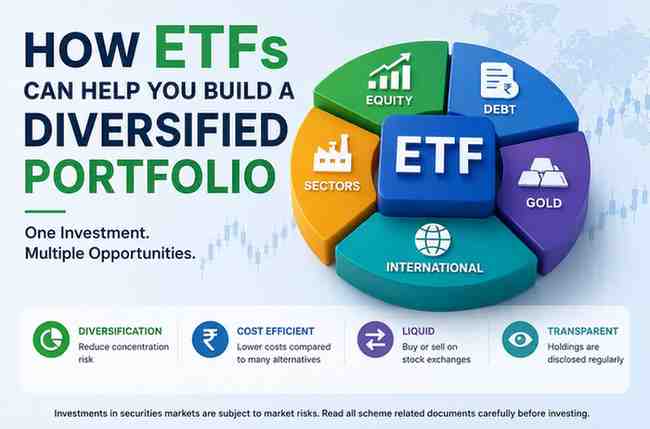
How ETFs Can Help You Build a Diversified Portfolio
How ETFs Can Help You Build a Diversified Portfolio
Investors often hear the phrase, “Don’t put all your eggs in one basket.” In investing, this principle is known as diversification—a strategy that aims to spread investments across different assets to reduce concentration risk.
However, building a diversified investment portfolio can sometimes seem challenging, especially for investors who have limited capital or time to research multiple securities. This is where Exchange Traded Funds (ETFs) can play a useful role.
ETFs provide exposure to a basket of securities through a single investment vehicle, making them a practical option for investors looking to diversify their portfolios. In this article, we explore how ETFs work, their role in portfolio construction, and the benefits of ETF investing for long-term investors.
What Are Exchange Traded Funds (ETFs)?
Exchange Traded Funds (ETFs) are investment instruments that typically track the performance of an index, sector, commodity, or basket of assets. ETFs are listed on stock exchanges and can be bought and sold during market hours, similar to shares.
For example, an ETF tracking the Nifty 50 Index generally aims to replicate the performance of the underlying index by holding its constituent stocks in similar proportions.
ETFs can provide exposure to:
- Equity markets
- Debt instruments
- Gold and other commodities
- International markets
- Sector-specific themes
Because they combine multiple securities into a single investment, ETFs can support ETF portfolio diversification without requiring investors to purchase each security individually.
Why Diversification Matters
Diversification is a risk-management strategy that involves allocating investments across different asset classes, sectors, and geographies.
The objective is not necessarily to maximize returns but to reduce the impact of poor performance from a single investment.
Consider an investor who allocates all capital to one stock. If that company faces business challenges, the portfolio may experience significant volatility. On the other hand, a diversified investment portfolio spreads exposure across multiple holdings, potentially reducing concentration risk.
Diversification can be implemented across:
| Diversification Type | Example |
| Asset Class Diversification | Equity, debt, gold |
| Sector Diversification | Banking, IT, healthcare, FMCG |
| Geographic Diversification | India and international markets |
| Market Capitalization Diversification | Large-cap, mid-cap, small-cap |
ETFs can help investors achieve several of these diversification objectives through a single investment product.
How ETFs Can Help You Build a Diversified Portfolio
- Exposure to Multiple Securities Through One Investment
One of the key benefits of ETF investing is that a single ETF can provide exposure to numerous securities.
For instance, a broad-market index ETF may hold dozens of stocks across different sectors. Instead of purchasing each stock separately, investors gain diversified exposure through one transaction.
This can simplify portfolio construction while reducing the effort required to monitor multiple investments.
- Access to Different Asset Classes
Modern ETFs cover a wide range of asset classes beyond equities.
Investors can consider:
- Equity ETFs
- Gold ETFs
- Debt ETFs
- International ETFs
Combining different asset classes may help create a more balanced portfolio aligned with individual financial goals and risk tolerance.
For example, an investor seeking long-term growth may combine equity ETFs with gold ETFs to diversify exposure across different market environments.
- Sector and Theme Diversification
Some investors prefer targeted exposure to specific sectors such as banking, information technology, or healthcare.
Sectoral ETFs allow investors to participate in particular industries without selecting individual stocks. While sector-specific investments may carry concentration risk, they can complement a broader portfolio when used thoughtfully.
A diversified ETF portfolio may include both broad-market ETFs and selective sector allocations.
- International Market Exposure
Global diversification is increasingly accessible through ETFs.
International ETFs enable investors to gain exposure to overseas markets and companies without directly investing in foreign stocks.
This can help reduce dependence on a single economy and broaden investment opportunities across different regions.
When evaluating international investments, investors should consider factors such as currency fluctuations, market conditions, and investment objectives.
- Cost Efficiency
Many ETFs are passively managed and designed to track an index rather than actively selecting securities.
As a result, ETFs often have lower expense ratios compared to certain actively managed investment products.
Lower costs can potentially enhance long-term investment outcomes, particularly when investments are held over extended periods.
How to Invest in ETFs
For investors wondering how to invest in ETFs, the process is relatively straightforward.
Step 1: Open a Demat and Trading Account
Since ETFs trade on stock exchanges, investors generally require a demat account and a trading account.
Step 2: Define Your Investment Goals
Determine whether your objective is:
- Wealth creation
- Retirement planning
- Portfolio diversification
- Gold allocation
- International exposure
Your goals can influence ETF selection.
Step 3: Evaluate ETF Characteristics
Before investing, consider:
- Underlying index
- Expense ratio
- Liquidity
- Tracking error
- Asset allocation fit
Reviewing scheme-related documents and understanding the product structure can help investors make informed decisions.
Step 4: Invest Systematically
Many investors choose to invest periodically rather than making large lump-sum investments. A disciplined investment approach can help manage market fluctuations over time.
Benefits of ETF Investing for Retail Investors
ETFs offer several features that appeal to retail investors:
- Diversification through a single investment
- Transparency of holdings
- Exchange-traded liquidity
- Access to multiple asset classes
- Lower portfolio management effort
- Potentially lower costs compared to some investment alternatives
These features make ETFs a commonly used component in modern portfolio-building strategies.
Common Considerations before Investing in ETFs
While ETFs can support diversification, investors should keep a few factors in mind:
- ETFs are subject to market risk.
- Returns are not guaranteed.
- Liquidity can vary between ETFs.
- Sectoral and thematic ETFs may involve concentration risk.
- International ETFs may be affected by global market and currency movements.
Investors should evaluate whether an ETF aligns with their financial objectives, risk appetite, and investment horizon.
Conclusion
Building a diversified investment portfolio is an important aspect of long-term investing, and ETFs can provide a convenient way to achieve broader market exposure. Whether investors seek equity participation, gold allocation, debt exposure, or international diversification, Exchange Traded Funds (ETFs) offer a flexible framework for portfolio construction.
Rather than relying heavily on a single stock, sector, or asset class, investors can use ETFs to spread exposure across multiple investments. While diversification does not eliminate risk, it can help manage concentration risk and support a more balanced investment approach.
As with any investment decision, investors should carefully review scheme-related information, understand the risks involved, and consider seeking professional financial advice where appropriate.
About GigaPro: Beyond basic trading, GigaPro mobile trading app equips users with a suite of advanced features to enhance their trading strategies. Download the app today to start your trading journey on your Android device: (Download GigaPro Mobile App) or on your Apple device: (Download GigaPro Mobile App).
Sources and Official References
Securities and Exchange Board of India
Association of Mutual Funds in India
NSE Indices Limited
BSE Limited
Related Blogs:
Build a Stronger Investment Portfolio Through Diversification
Tips for Diversifying Your Investment Portfolio
Using Commodity ETFs for Portfolio Risk Reduction
How Global Commodity Prices Influence Quoted Prices in India
How to Use Mutual funds and ETFs for Instant Portfolio Diversification
How Quoted Prices Are Determined in Commodity Exchanges
What is Quoted Price in Commodity Trading?
What is Commodity Trading?
How to Diversify Your Portfolio with Commodities: A Strategic Approach
The Rising Appeal of Commodities for Indian Investors
Top Strategies and Tips for Maximizing Profits in Commodity Trading
Different Types of Commodities and Their Trading Characteristics
Beyond Stocks: Exploring the World of Commodities
Diversification Strategies: Combining Commodities and Equities
Commodity vs Equity Market: A Beginner’s Guide to Understanding the Differences
What are Commodities? Understanding the Basics
Why Energy Commodities Deserve a Spot in Your Indian Investments
Disclaimer: This blog post is intended for informational purposes only and should not be considered financial advice. The financial data presented is subject to change over time, and the securities mentioned are examples only and do not constitute investment recommendations. Always conduct thorough research and consult with a qualified financial advisor before making any investment decisions.
Are ETFs safer than individual stocks for diversification?
ETFs provide exposure to multiple securities through a single investment, which can reduce concentration risk compared to investing in a single stock. However, ETFs remain subject to market risks and their value can fluctuate.
How can beginners invest in ETFs in India?
Investors can buy ETFs through a demat and trading account on NSE or BSE. Before investing, they should evaluate factors such as expense ratio, liquidity, tracking error, and investment objectives.
What is the difference between ETFs and mutual funds?
While both offer diversified exposure, ETFs trade on stock exchanges throughout the day like shares, whereas mutual fund units are typically bought and redeemed at end-of-day NAV.