
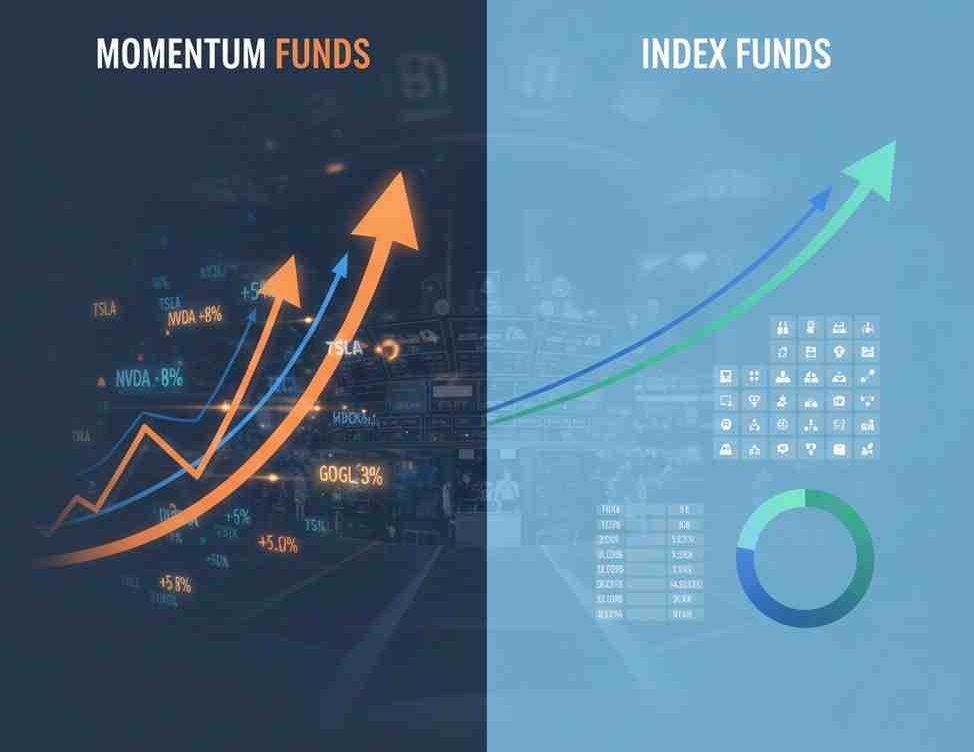
Momentum Funds vs Index Funds: Which One Aligns With Your Strategy?
Momentum Funds vs Index Funds: Which One Aligns With Your Strategy?
When planning an investment approach, many individuals compare different fund categories to understand which aligns better with their long-term financial goals. Among the options available, the discussion around momentum funds vs index funds has gained attention in recent years. While both are equity-oriented strategies, they differ in approach, risk behaviour, and expectations. Understanding these differences helps investors select an option that fits their needs, investment horizon, and comfort with market fluctuations.
This article breaks down the difference between momentum and index funds, how each type works, and what you should consider while choosing between them.
Understanding Momentum Funds
Momentum funds follow a rule-based investment strategy designed to pick stocks that exhibit strong recent performance. The philosophy behind momentum investing suggests that stocks showing upward movement may continue to remain in trend for some time. These funds rely on quantitative models to identify such opportunities.
The selection process typically involves ranking stocks based on factors such as price strength, relative returns, and trend consistency. Since these portfolios are updated regularly—often every month or quarter—momentum funds may experience higher turnover compared with other categories.
For investors analysing momentum investing vs passive investing, this category clearly falls under a rule-driven, factor-based strategy that aims to capture trends rather than mirror a benchmark.
Understanding Index Funds
Index funds are designed to replicate the performance of a specific index such as the Nifty 50, Sensex, Nifty Midcap 150, or other diversified indices. They are part of the passive investing space and follow a simple principle—match the index constituents in the same proportion and allow market movements to dictate performance.
Because index funds do not aim to outperform their benchmark, the objective is to provide returns similar to the index after costs. This reduces the need for active fund management and can lead to lower costs and lower portfolio turnover.
Investors often prefer index funds for their transparency and market-linked behaviour, especially when they seek simplicity or long-term wealth building without constant portfolio adjustments.
Momentum Funds vs Index Funds: How Do They Differ?
When comparing momentum funds vs index funds, the contrast lies mainly in the investment approach:
- Strategy
- Momentum funds select stocks based on recent price movements and quantitative signals.
- Index funds simply replicate the composition of a chosen benchmark.
- Portfolio Turnover
- Momentum strategies involve frequent rebalancing.
- Index funds undergo changes only when index constituents are updated.
- Cost Structure
- Since index funds mirror an index, they generally have lower management costs.
- Momentum funds, due to frequent adjustments and deeper research, may have higher associated costs.
- Behaviour During Market Cycles
- Momentum strategies may perform differently during strong market trends.
- Index funds maintain stability in approach and reflect overall market conditions.
These points help investors understand the difference between momentum and index funds from a structural perspective.
Suitability: Which Approach Fits Your Investment Style?
A common question among investors is: Which is better, momentum or index fund? The answer depends entirely on personal preferences, risk tolerance, and the type of exposure one is seeking.
- When Momentum Funds May Appeal
Momentum funds might be preferred by investors who:
- Are comfortable with a rules-based strategy
- Can accept portfolio changes frequently
- Want exposure to market trends led by strong-performing stocks
- Understand that returns can vary depending on the strength of momentum cycles
Momentum funds can add diversification to a portfolio by offering exposure to a factor-driven approach rather than purely market-weighted investment.
- When Index Funds May Suit Better
Index funds may be suitable for those who:
- Prefer passive investing and consistent market-linked behaviour
- Want lower costs and simpler fund structures
- Look for long-term market participation without active decision-making
- Are building core portfolios for financial goals such as retirement, children’s education, or long-term wealth creation
In such cases, index funds offer a clearer and simpler way to invest in the broader market.
Factors to Consider When Choosing Between Momentum and Index Funds
When choosing between momentum and index funds, you may want to evaluate the following aspects:
- Investment Horizon
Momentum strategies may be more sensitive to short-term market behaviour. Index funds may be suitable for longer horizons where market growth can compound consistently.
- Risk Appetite
Momentum funds can carry higher volatility due to concentrated picks based on recent performance. In contrast, index funds are built to represent broader, diversified exposure.
- Objective of Investment
If you want factor-based exposure or an alternative strategy, momentum funds may fit your needs. If you prefer market-linked growth, index funds may be easier to integrate into your financial planning.
- Understanding of Strategy
Momentum investing uses quantitative rules, while index investing follows passive principles. The decision may also depend on the level of comfort and clarity you have with each.
Conclusion
Both momentum funds and index funds serve different purposes in an investor’s portfolio. Momentum strategies aim to capture trends through data-driven selection, while index funds aim to mirror broad market behaviour. Choosing between the two depends on factors such as your investment horizon, risk tolerance, and overall financial goals.
When you evaluate which is better, momentum or index fund, it helps to understand how each behaves across different market conditions. This ensures that your choice aligns with your broader investment strategy and financial objectives.
About GigaPro: Beyond basic trading, GigaPro mobile trading app equips users with a suite of advanced features to enhance their trading strategies. Download the app today to start your trading journey on your Android device: (Download GigaPro Mobile App) or on your Apple device: (Download GigaPro Mobile App).
Related Blogs:
Top Mistakes Investors Make While Investing in Momentum Funds
ETF Investing in India: A Beginner’s Guide to Passive Wealth
Understanding Index Funds in the Indian Market
Index Funds vs Mutual Funds: Which One Should You Pick?
Understanding Commodity Markets for Investment Opportunities
What is Sector Rotation and How Does it Work?
How to Implement Diversification for a Profitable Portfolio
Build a Stronger Investment Portfolio Through Diversification
Diversification Strategies: Combining Commodities and Equities
Diversification Strategies: Why Spreading Your Risk Matters
How to Use Sector Rotation to Diversify Your Portfolio
Different Types of Commodities and Their Trading Characteristics
Disclaimer: This blog post is intended for informational purposes only and should not be considered financial advice. The financial data presented is subject to change over time, and the securities mentioned are examples only and do not constitute investment recommendations. Always conduct thorough research and consult with a qualified financial advisor before making any investment decisions.