

What Are the Most Common Earnings Manipulation Red Flags Identified by SEBI and Auditors?
What Are the Most Common Earnings Manipulation Red Flags Identified by SEBI and Auditors?
SEBI, auditors, and accounting watchdogs identify specific red flags in financial reporting that may suggest earnings manipulation or financial statement irregularities. Recognising these signs — such as mismatched cash flows, aggressive accounting policy changes, or qualified audit opinions — helps investors distinguish genuine performance from potential misrepresentation.
Thank you for reading this post, don't forget to subscribe!Introduction: Why Red Flags Matter for Investors
Financial statements are meant to provide a “true and fair view” of a company’s performance and position. However, at times, companies resort to aggressive accounting or even outright manipulation to meet market expectations, hide weaknesses, or inflate earnings.
Earnings manipulation can mislead shareholders, distort valuations, and destroy investor wealth when true performance eventually emerges. India’s securities regulator — the Securities and Exchange Board of India (SEBI) — along with auditors and the National Financial Reporting Authority (NFRA), emphasise transparency and robust financial reporting to protect investor interests.
Below, we cover the most common earnings manipulation red flags that investors should watch for.
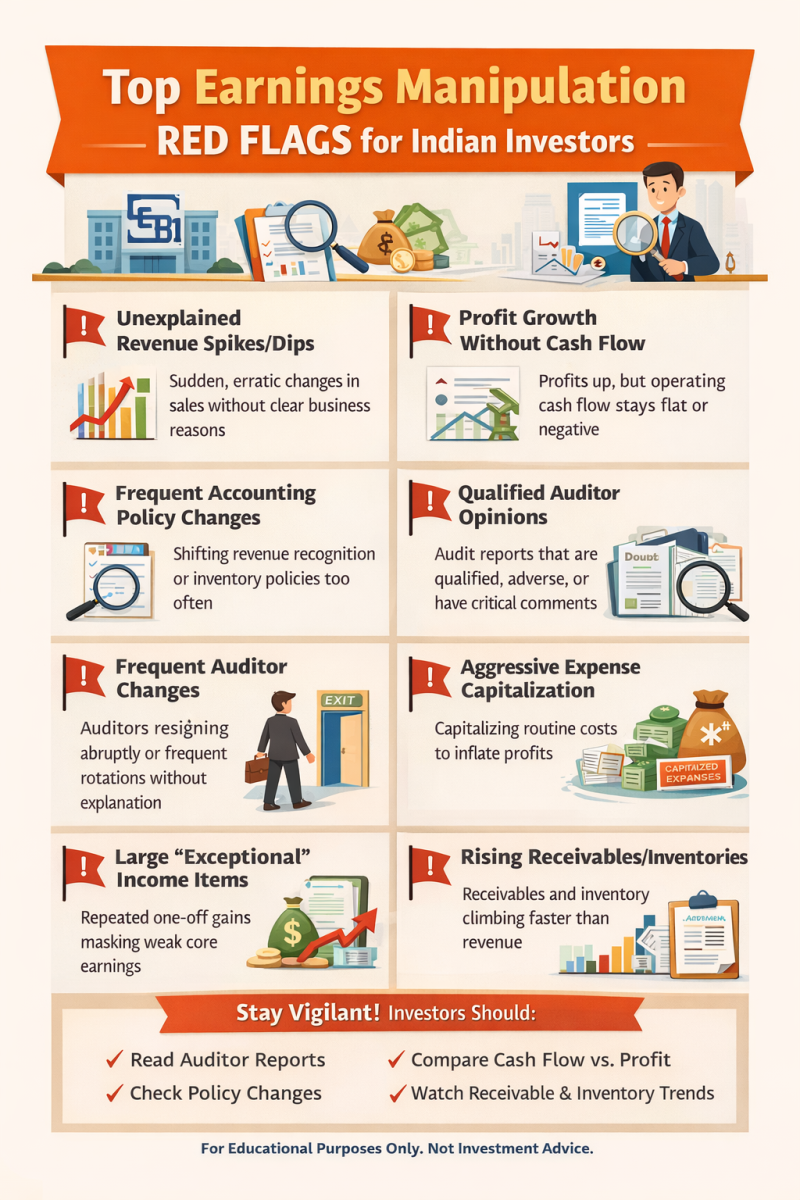
1. Sudden, Unexplained Spikes or Dips in Revenue
One of the most straightforward warnings of earnings manipulation is sharp revenue changes without clear business drivers.
-
Unusual revenue spikes at year-end can signal channel stuffing — where excess products are shipped to distributors before quarter-end to inflate sales.
-
Similarly, a sudden drop in sales without an operational reason can indicate delayed recognition of losses.
If revenue movements outpace industry peers or lack a supporting operational story, investors should be cautious.
2. Profit Growth Without Corresponding Cash Flow
A recurring red flag is when accounting profits rise but cash from operations weakens or remains stagnant.
Cash inflows are harder to manipulate than accrual-based profits. When profits improve but operating cash flow is negative, it could mean:
-
Revenues were recognised prematurely
-
Receivables were booked without corresponding collections
-
One-off gains were used to uplift earnings artificially
Retail investors should always check the Statement of Cash Flows alongside the Income Statement to validate earnings quality.
3. Frequent Changes in Accounting Policies
Companies should have consistent accounting treatments over time. However, manipulative practices sometimes involve frequent changes to critical accounting assumptions — such as:
-
Revenue recognition criteria
-
Inventory valuation methods
-
Depreciation or amortisation policies
While policy changes may sometimes be justified, repeated adjustments without clear rationale may mask earnings manipulation. Auditors are expected to scrutinise these changes and disclose them in the notes to accounts.
4. Qualified or Modified Audit Opinions
A clean audit opinion indicates that the financials are presented fairly in all material respects. But when auditors issue a qualified, adverse, or emphasis-of-matter opinion, it’s a red flag.
These qualifications often arise because auditors found issues they could not resolve, such as:
-
Doubts about going concern assumptions
-
Material uncertainty in revenue recognition
-
Incomplete confirmations for receivables or payables
-
Non-compliance with accounting standards (e.g., revenue or inventories)
Investors should treat such audit opinions as a prompt to dig deeper rather than accept the financials at face value.
5. Frequent Changes in Auditors or Auditor Resignations
Statutory auditors provide independent verification of financial statements. Sudden or frequent auditor changes — especially resignations citing disagreements with management — can be a major red flag.
Auditor turnover may indicate disputes over accounting treatments, inability to obtain evidence, or management obstruction. SEBI and NFRA both emphasise auditor independence as critical for credible reporting.
6. Aggressive Expense Capitalisation
When expenses that should normally be expensed are capitalised instead, profits can be overstated in the current period and deferred to future periods.
Examples include:
-
Capitalising routine operating costs
-
Overstating asset values to reduce expenses
-
Minimising provisions for doubtful debts or warranties
Such practices boost earnings temporarily but can distort future profit expectations. Auditors are required to challenge aggressive capitalisation and report unusual practices.
7. Large “Non-Recurring” or “Exceptional” Items
Companies sometimes label recurring business results as “one-off” or “exceptional” to smooth earnings or mask weak operational performance.
If a company consistently reports large exceptional gains (such as asset revaluations or settlement receipts), investors should question whether these are genuinely one-off or being used to inflate earnings artificially.
8. Rising Receivables or Inventory Outpacing Sales
A disproportionate increase in:
-
Accounts receivable
-
Inventory levels
relative to sales growth can suggest: -
Early revenue recognition
-
Unsold stock being counted as sales
-
Inflated demand projections
These patterns are often cited by forensic auditors as signs of aggressive revenue booking or earnings management.
9. Frequent Restatements or Audit Adjustments
Restatements occur when previous financial statements are corrected due to material errors.
Frequent restatements — particularly those that reverse profits or reclassify revenue/expenses — suggest underlying reporting issues and lower confidence in management’s accounting practices.
Investors should ask:
“Is the restatement due to a genuine error, or is it hiding a deeper pattern of aggressive reporting?” — especially when industry outlook hasn’t changed.
10. Mismatches Between FY Results and Regulatory Filings
If a company’s reported turnover or profits differ significantly across disclosures to:
-
Registrar of Companies
-
Tax authorities
-
Stock exchanges
this inconsistency warrants scrutiny. Mismatches may be due to regulatory timing differences, but material gaps without explanation can be a warning sign.
Nigeria and India: Lessons from Historic Scandals
One of India’s most notorious financial frauds was the Satyam Computers scandal, where revenues and cash balances were inflated for years before the fraud was exposed. Auditors failed to detect missing cash and fictitious invoices, leading to regulatory penalties and loss of investor trust.
Such cases highlight the real cost of ignoring red flags — not just to shareholders but to market confidence.
What Regulators and Auditors Do About Red Flags
SEBI’s regulations on Prohibition of Fraudulent and Unfair Trade Practices make it unlawful to disseminate misleading financial information that affects security prices.
Meanwhile, the National Financial Reporting Authority (NFRA) oversees audit quality and enforces compliance with accounting and auditing standards in India. NFRA reviews and sanctions auditors for negligence and failure to flag issues, emphasising the role of auditors as watchdogs, not accomplices.
Additionally, under the Companies Act, 2013, auditors must report suspected fraud to the regulator and audit committee and in many cases must file statutory forms to the government if fraud above specified thresholds is detected.
This regulatory and audit framework creates multiple layers of oversight to catch earnings manipulation early.
How Retail Investors Should Use This Knowledge
1. Always read the Notes to Accounts
Detailed disclosures often hide red flags not obvious in summary financials.
2. Compare cash flows and profits
Profits that aren’t backed by cash flows often deserve skepticism.
3. Watch auditor reports and qualifications
A qualified opinion is rarely a positive signal.
4. Look at trends, not single quarters
Persistent patterns matter more than one-off anomalies.
5. Verify disclosures across platforms
Annual reports, exchange filings, and statutory disclosures should be consistent.
Sources & References
SEBI – Prohibition of Fraudulent & Unfair Trade Practices:
https://www.sebi.gov.in/acts/futpfinal.html
National Financial Reporting Authority (NFRA) – Homepage (audit oversight):
https://nfra.gov.in/
NFRA – Role, Powers & Functions (Taxmann summary):
https://www.taxmann.com/post/blog/national-financial-reporting-authority-nfra
NFRA & Audit Quality Concerns – ET CFO:
https://cfo.economictimes.indiatimes.com/news/tax-legal-accounting/audit-quality-in-india-under-scrutiny/125882508
Auditor’s Responsibilities in Reporting Fraud – NFRA Circular:
https://nfra.gov.in/document/statutory-auditors-responsibilities-in-relation-to-fraud-in-a-company-2/
Common Financial Red Flags – Forensic Audit Guides:
Revenue spikes, cash flow mismatch, aggressive accounting policies, receivables growth, etc.
Satyam Scandal (Wikipedia overview):
https://en.wikipedia.org/wiki/Satyam_scandal
Related Blogs:
Understanding Cash Flow Statements for Investors
Understanding the Income Statement: A Beginner’s Guide
How to Read a Company’s Balance Sheet Before Investing
How to Analyze Management Guidance vs Actual Performance
How to Use Annual Reports to Evaluate a Company
How Management Commentary in Earnings Calls Can Reveal Future Risks
How to Evaluate Management Quality: A Key Pillar of Smart Investing
Disclaimer: This blog post is intended for informational purposes only and should not be considered financial advice. The financial data presented is subject to change over time, and the securities mentioned are examples only and do not constitute investment recommendations. Always conduct thorough research and consult with a qualified financial advisor before making any investment decisions.
Q1. What is “earnings manipulation”?
Earnings manipulation involves adjusting financial results — legally or illegally — to present a more favourable picture than actual performance.
Q2. Can earnings manipulation be legal?
Some aggressive accounting practices may be technically legal but can mislead investors if not transparently disclosed.
Q3. Are red flags definitive proof of fraud?
No. Red flags are warning signs that require deeper analysis, not automatic proof.
Q4. How often should investors monitor red flags?
Investors should regularly examine quarterly and annual results for red flags as part of ongoing research.
