


How to Build an Investment Thesis?
How to Build an Investment Thesis?
Successful investing isn’t about reacting to market noise or blindly following the latest trend. It’s about having a structured, well-researched, and conviction-driven approach—and that starts with building a solid investment thesis.
Thank you for reading this post, don't forget to subscribe!An investment thesis is a written reasoning that explains why you are investing in a company, what you expect from it, and what could go wrong. It acts as a roadmap that guides your buy, hold, and sell decisions with clarity—not emotions.
For retail and emerging investors, understanding how to build a strong thesis can be a game-changer. Let’s break it down step-by-step.
What Is an Investment Thesis?
An investment thesis is a concise statement that lays out:
-
The core reason for investing in a company
-
The drivers of future growth
-
The valuation comfort
-
Key risks to monitor
Think of it as a logical argument that answers:
“Why this company? Why now? And what should I expect?”
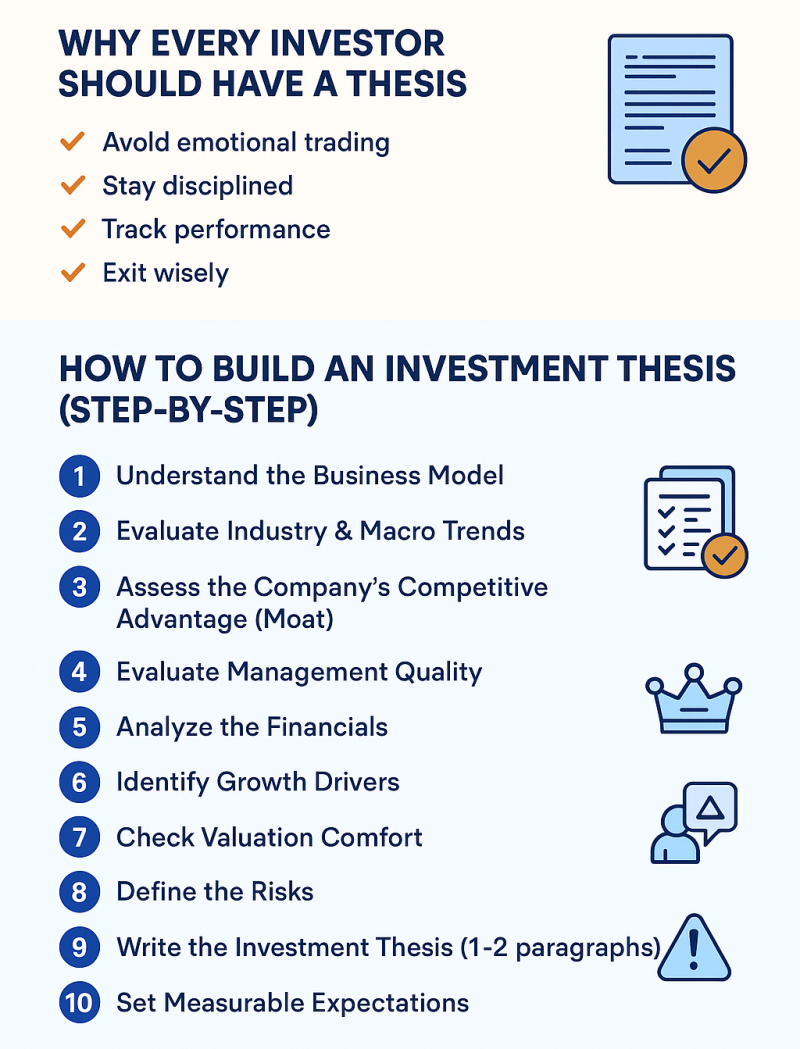
Why Every Investor Should Have a Thesis
A well-crafted thesis helps you:
✓ Avoid emotional trading
You won’t panic when the stock dips, because your decision is based on fundamentals.
✓ Stay disciplined
You know what you’re looking for—and what you’re avoiding.
✓ Track performance
You can compare your expectations vs. reality.
✓ Exit wisely
If the thesis breaks, you exit. Not because markets are volatile.
How to Build an Investment Thesis (Step-by-Step)
1. Understand the Business Model
Start with the basics:
-
What does the company do?
-
How does it earn money?
-
What products/services drive revenue?
-
Does it have pricing power?
-
Is demand cyclical or stable?
A clear understanding of the business is the foundation of your thesis.
2. Evaluate Industry & Macro Trends
A great company in a declining industry may struggle.
A decent company in a fast-growing industry may thrive.
Study:
-
Industry growth rates
-
Market size
-
Competitive intensity
-
Regulation impact
-
Technological shifts
-
Cyclicality patterns
Ask yourself:
Is the wind behind the company’s back—or against it?
3. Assess the Company’s Competitive Advantage (Moat)
A strong investment thesis typically identifies a moat, such as:
-
Strong brand (e.g., Titan)
-
Network effects (e.g., Zomato)
-
Cost leadership (e.g., DMart)
-
Patents/IP (e.g., Pharma firms)
-
High switching costs (e.g., Software providers)
A moat increases the probability of consistent long-term performance.
4. Evaluate Management Quality
The best business idea can fail under poor leadership.
Check:
-
Track record and integrity
-
Capital allocation decisions
-
Corporate governance
-
Communication transparency
-
Past scandals or conflicts
Strong management protects long-term shareholder value.
5. Analyze the Financials
Now move to the numbers. Focus on:
Profitability:
ROE, ROCE, OPM, NPM, gross margins
Growth:
Revenue CAGR, profit CAGR
Balance Sheet Stability:
Debt-to-equity, interest coverage
Cash Flow Strength:
Free cash flow generation, working capital cycle
Capital Allocation:
Reinvesting in growth? Paying dividends? Acquisitions?
A company with profits + cash flows + low debt is ideal.
6. Identify Growth Drivers
Ask yourself:
What will make earnings grow in the next 3–5 years?
Growth may come from:
-
Capacity expansion
-
New product launches
-
Entry into new geographies
-
Margin improvement
-
Industry upcycles
-
Market share gains
-
Digital transformation
Your thesis should clearly list these future triggers.
7. Check Valuation Comfort
Even a great company is a bad investment at the wrong price.
Compare:
-
PE, PB, EV/EBITDA vs industry peers
-
DCF for long-term value
-
Historical valuation ranges
Then decide:
Is the stock fairly priced, overvalued, or undervalued?
8. Define the Risks
A strong thesis includes risk factors such as:
-
High debt
-
Commodity price dependence
-
Regulatory uncertainty
-
Currency exposure
-
Customer concentration
-
Technology disruption
-
Geopolitical risks
Understanding risks helps you avoid blind spots.
9. Write the Investment Thesis (1–2 paragraphs)
Combine all insights into a clear thesis. For example:
“ABC Ltd is a market leader in industrial automation with strong pricing power, improving margins, and a robust order book. The company is set to benefit from India’s manufacturing capex cycle and automation growth. With strong cash flows, low debt, and ROCE of 20%, ABC Ltd offers attractive long-term potential. Key risks include global slowdown and input cost volatility.”
This becomes your reference point.
10. Set Measurable Expectations
Define what will validate your thesis:
-
Revenue growth target (e.g., 15% CAGR)
-
Margin improvement
-
Market share gains
-
ROCE levels
-
Stock return expectations
-
Time horizon (3–5 years is ideal)
A Sample Investment Thesis Template
You can use this format:
Business Overview:
Industry Context:
Competitive Advantage:
Management:
Financial Strength:
Growth Drivers:
Valuation:
Risks:
Final Thesis Statement (2–3 sentences):
Final Thoughts
Building an investment thesis brings structure, clarity, and confidence to your investing process. It transforms you from a reactive trader into a disciplined investor.
You don’t need to be an expert analyst.
You just need to follow a framework.
With practice, writing an investment thesis becomes second nature—and your investment decisions become significantly smarter.
Related Blogs:
How to Use Annual Reports to Evaluate a Company
How to Analyze Sector Trends Before Investing: A Practical Guide for Retail Investors
What Drives Value Investing in Different Economic Cycles
How to Use Fundamental Analysis for Indian Stocks
How to Read a Company’s Balance Sheet: Step-by-Step with Indian Examples
Profit & Loss Statement: What Matters for Retail Investors in India
Cash Flow Statement: Why It’s More Important Than Net Profit
How to Evaluate Management Quality: A Key Pillar of Smart Investing
Disclaimer: This blog post is intended for informational purposes only and should not be considered financial advice. The financial data presented is subject to change over time, and the securities mentioned are examples only and do not constitute investment recommendations. Always conduct thorough research and consult with a qualified financial advisor before making any investment decisions.
