

Index Funds vs Actively Managed Funds: Cost, Risk, and Returns
Index Funds vs Actively Managed Funds: Cost, Risk, and Returns
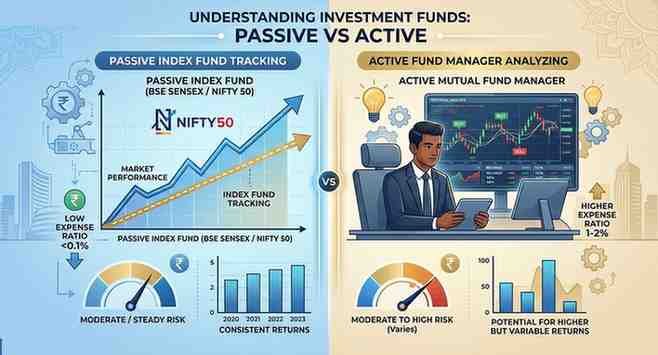
As Indian investors gain greater access to low-cost investment products, the comparison between index funds vs actively managed funds has become increasingly relevant. Both vehicles help investors participate in equity markets, but they differ in cost structure, risk profile, and return consistency.
Thank you for reading this post, don't forget to subscribe!- Index funds aim to match market returns at a low cost.
- Actively managed funds attempt to beat the market through research-driven stock selection.
Understanding when each approach may fit better can help retail investors make more informed long-term allocation decisions.
What Are Index Funds?
Index funds are passive investment vehicles designed to replicate the performance of a specific market benchmark such as the Nifty 50 or Sensex. Instead of trying to outperform, the objective is to closely track the index return (before costs).
The rising interest in index fund benefits in India is largely driven by simplicity, transparency, and cost efficiency.
Key Features of Index Funds
- Rules-based portfolio construction
- Lower expense ratios
- Minimal fund manager intervention
- High transparency
- Low portfolio churn
Because index funds follow a predefined basket of securities, their performance usually deviates from the benchmark only by tracking error and expenses.
What Are Actively Managed Mutual Funds?
Actively managed mutual funds rely on professional fund managers who select stocks based on research, valuation models, and market outlook. Their goal is to generate alpha, or returns above the benchmark.
In the active vs passive funds India discussion, active funds offer flexibility but also introduce manager-dependent outcomes.
Key Characteristics of Active Funds
- Research-intensive investment process
- Higher portfolio turnover
- Greater return dispersion
- Higher expense ratios
- Tactical allocation flexibility
Fund managers may adjust sector exposure, hold cash during volatility, or attempt to identify mispriced opportunities.
Active vs Index Funds: Key Differences
| Feature | Index Funds | Actively Managed Funds |
| Objective | Match the benchmark | Beat the benchmark |
| Management style | Passive, rules-based | Research-driven |
| Expense ratio | Usually lower | Usually higher |
| Portfolio churn | Low | Higher |
| Manager risk | Minimal | Significant |
| Return pattern | Market-linked | Variable |
| Best suited for | Core long-term allocation | Selective alpha seeking |
This comparison shows why many modern portfolios use both approaches rather than treating them as mutually exclusive.
Cost Comparison: Why Expense Ratio Matters
One of the most important differentiators in expense ratio mutual funds India comparisons is cost.
Index Funds
- Lower operating costs
- Minimal research expenses
- Automated portfolio tracking
Active Funds
- Research team costs
- Active trading expenses
- Fund manager expertise
- Higher distribution costs
Over long investment horizons, even a 1% higher annual expense can meaningfully reduce final corpus due to compounding effects. This is one of the primary reasons passive investing has gained traction among cost-conscious Indian investors.
Risk and Return Considerations
The return experience between active funds and index funds can vary across market segments and time periods.
Index Funds Typically Offer
- Market-linked returns
- Low manager risk
- Predictable relative performance
- Full participation in market ups and downs
Active Funds May Offer
- Potential outperformance (not guaranteed)
- Tactical flexibility
- Higher variability in outcomes
- Manager selection risk
In India, large-cap markets are relatively efficient, which has made consistent long-term outperformance challenging for many active funds. However, mid-cap and small-cap segments sometimes show higher dispersion, where skilled managers may add value.
Investors should always evaluate full market-cycle performance, not short-term rankings.
Which Option May Suit Retail Investors?
There is no universal answer to which is better — index fund or active fund in India. Suitability depends on multiple factors:
- Cost sensitivity
- Investment horizon
- Risk tolerance
- Preference for simplicity vs active oversight
- Comfort with fund manager selection
Index Funds May Suit Investors Who
- Prefer low-cost investing
- Want market-linked returns
- Have long investment horizons
- Prefer minimal monitoring
- Want to avoid manager risk
Active Funds May Suit Investors Who
- Seek potential alpha
- Are comfortable evaluating fund managers
- Can tolerate higher costs
- Are investing in less efficient segments
- Prefer tactical flexibility
The Blended Approach
Many Indian investors now follow a core–satellite strategy:
Core (Passive Allocation)
- Index funds
- Broad market exposure
- Low-cost long-term holdings
Satellite (Active Allocation)
- Select high-conviction funds
- Tactical opportunities
- Alpha-seeking strategies
This structure aims to balance cost efficiency with selective outperformance potential.
Conclusion
The choice between index funds and actively managed funds is not about identifying a universal winner but about aligning the strategy with your investment objectives, cost sensitivity, and risk tolerance. Index funds offer a low-cost, transparent, and predictable way to capture market returns, making them well suited for core long-term allocations. Actively managed funds, on the other hand, provide the potential for alpha through research-driven stock selection, though outcomes can vary and costs are typically higher. For many Indian retail investors, a balanced core–satellite approach that combines passive stability with selective active exposure may provide a more practical path toward long-term portfolio growth.
Sources and Official References
Securities and Exchange Board of India
Association of Mutual Funds in India
NSE Indices Limited
BSE Limited
Related Blogs:
What Is an Inverse ETF and How Does It Work?
What Is Active Portfolio Management? Strategy, Benefits, and Risks
What Is Passive Investing? Index Funds and Long-Term Wealth Creation
Debt vs Equity Open-Ended Funds: How to Select Based on Risk Profile
Momentum Funds for Beginners: Factors to Consider Before You Start
What are Closed-Ended Mutual Funds?
Lump Sum Investments – How Is It Different from an SIP?
What Are Open Ended Mutual Funds?
What is Reversal Trading?
What Is an Auction Market and How Does It Work?
Understanding Mutual Fund SIP Returns: How to Calculate and Maximize Your Earnings
SIP Calculator and Inflation: Understanding How Inflation Impacts Your Mutual Fund Returns
SIP vs. Lumpsum: What’s the Best Way to Invest in Mutual Funds for Retirement?
How to Use a SIP Calculator for Investment Planning?
Reach Your Financial Milestones Sooner with Step-Up SIPs
What is a SIP Calculator and How Can It Help?
SIP vs Lump Sum: Which Investment Strategy Is Better?
Why Smart Investors in India are Choosing Systematic Investment Plan (SIPs)
How to Start a SIP for Your Child’s Education or Future Goals
The Power of SIPs: Why Consistency Beats Timing the Market
Disclaimer: This blog post is intended for informational purposes only and should not be considered financial advice. The financial data presented is subject to change over time, and the securities mentioned are examples only and do not constitute investment recommendations. Investors should conduct their own research or consult a registered advisor under the guidelines of the Securities and Exchange Board of India.
Do index funds always outperform active funds?
Not necessarily. Performance varies across time periods and market segments. Some active funds do outperform, though consistency is the key challenge.
Why are expense ratios important in mutual funds?
Higher costs directly reduce net returns and can significantly impact long-term compounding.
Can investors hold both index and active funds?
Yes. Many portfolios combine passive core holdings with selective active exposure.
Are index funds regulated in India?
Yes. Index funds and ETFs are regulated by SEBI under mutual fund regulations.
