


Why Do Many Indian Companies Show Seasonal Earnings Patterns and How Should Investors Adjust Expectations?
Why Do Many Indian Companies Show Seasonal Earnings Patterns and How Should Investors Adjust Expectations?
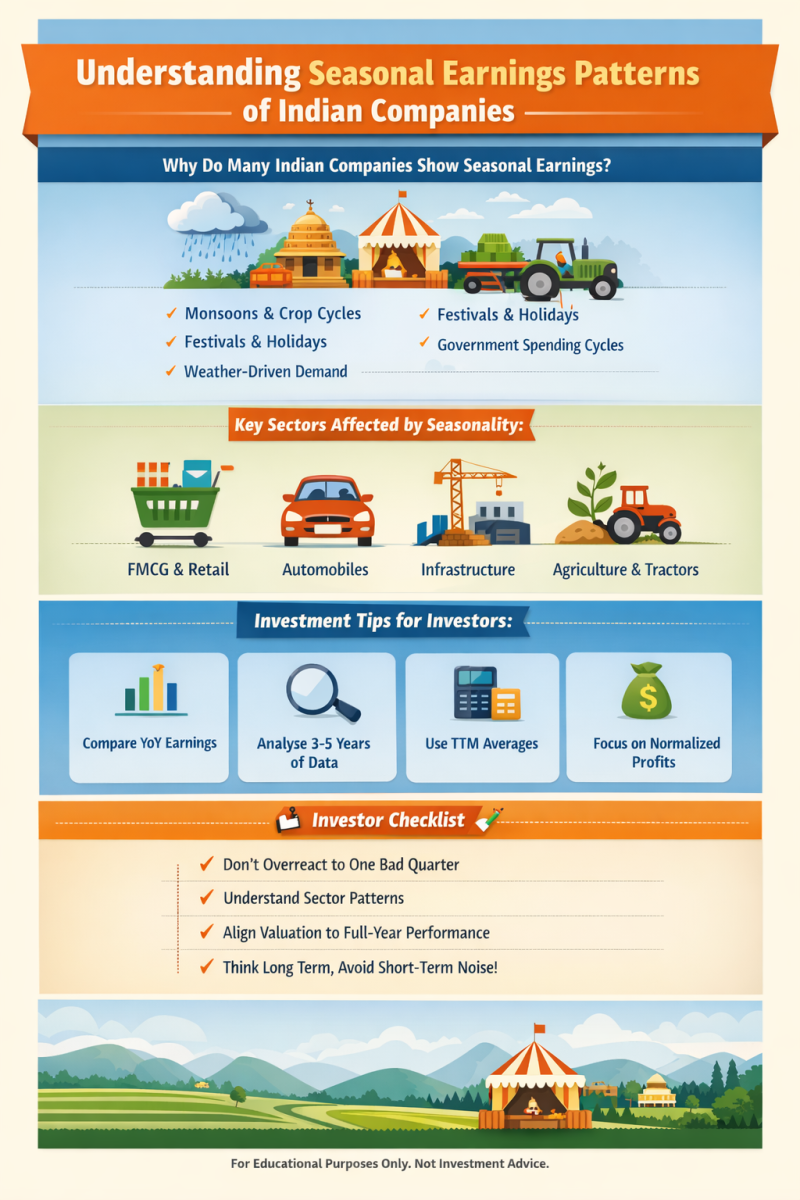
Many Indian companies exhibit seasonal earnings patterns due to demand cycles, monsoons, festive consumption, agricultural dependence, and government spending timelines. For investors, understanding seasonality helps separate temporary fluctuations from structural performance, enabling better earnings expectations and valuation decisions.
Thank you for reading this post, don't forget to subscribe!Introduction: Understanding Seasonality in Indian Corporate Earnings
Retail investors in India often get surprised by sharp swings in quarterly results—strong profits in one quarter followed by apparent weakness in the next. These fluctuations are frequently misinterpreted as operational deterioration or business recovery, when in reality they are driven by seasonal earnings patterns.
India’s economy is uniquely influenced by monsoons, festivals, agricultural cycles, fiscal spending calendars, and consumption behaviour, making seasonality a recurring feature across many listed companies. For long-term investors, recognising these patterns is essential to avoid knee-jerk reactions and poor investment decisions.
What Are Seasonal Earnings Patterns?
Seasonal earnings patterns refer to predictable fluctuations in revenues, costs, and profitability that recur at specific times of the year due to external or structural factors rather than changes in a company’s competitive position.
These patterns are:
-
Cyclical within a financial year
-
Often industry-specific
-
Repetitive over multiple years
Seasonality differs from cyclicality: while economic cycles span multiple years, seasonality repeats annually.
Why Seasonality Is Pronounced in India
1. Monsoon-Dependent Economy
Despite diversification, agriculture still influences rural demand, employment, and consumption.
-
Good monsoons boost farm incomes and rural spending
-
Weak monsoons impact FMCG, tractors, fertilisers, and agro-inputs
Source (RBI – Monetary Policy & Rural Demand):
https://www.rbi.org.in/scripts/annualpolicy.aspx
2. Festive Consumption Cycles
Festivals such as Diwali, Dussehra, Eid, and wedding seasons significantly influence demand.
Sectors impacted:
-
Consumer durables
-
Jewellery
-
Automobiles
-
Apparel and retail
Q2 and Q3 often show stronger topline growth due to festive-led spending.
3. Government Spending and Budget Cycles
Public sector and infrastructure-linked companies are affected by fiscal timelines.
-
Spending accelerates in the second half of the financial year
-
Q4 often sees execution push to meet annual budget targets
This impacts capital goods, EPC, defence, and PSU companies.
Source (Ministry of Finance – Union Budget & Expenditure Data):
https://www.indiabudget.gov.in/
4. Agricultural Sowing and Harvest Cycles
Agri-related businesses show strong seasonality tied to kharif and rabi cycles.
Affected sectors:
-
Fertilisers
-
Seeds
-
Agrochemicals
-
Tractor manufacturers
Sales often peak around sowing seasons rather than evenly through the year.
Source (Ministry of Agriculture – Crop Seasons):
https://agriwelfare.gov.in/en/CropSituation
5. Weather Sensitivity and Power Demand
Power, energy, and utilities experience demand swings driven by weather.
-
Summer boosts cooling demand
-
Monsoons affect hydro generation
-
Seasonal tariffs influence margins
Sector-Wise Examples of Seasonal Earnings in India
FMCG and Consumer Staples
-
Stronger sales during festivals and monsoon recovery
-
Input cost seasonality affects margins
Investor adjustment: Compare year-on-year quarterly data rather than sequential numbers.
Automobiles
-
Festive demand spikes
-
Inventory corrections between seasons
-
Rural demand linked to crop cycles
Investor adjustment: Look at wholesale and retail trends over a full year.
Infrastructure and Capital Goods
-
Q4-heavy revenue recognition
-
Delays in H1 due to approvals and weather
Investor adjustment: Annual order inflow and execution visibility matter more than quarterly EPS.
IT Services
-
Seasonality due to client budget cycles
-
Wage hikes and visa costs impacting specific quarters
Investor adjustment: Focus on deal wins, attrition, and constant-currency growth.
Banking and Financials
-
Credit growth varies across the year
-
Slippages often recognised in specific quarters
Investor adjustment: Track asset quality trends over multiple quarters.
India-Focused Case Studies
Case Study 1: Avenue Supermarts (DMart)
DMart typically reports stronger sales during festive and wedding seasons, while margins fluctuate due to inventory and pricing strategies.
Source (Avenue Supermarts Investor Presentations):
https://www.dmartindia.com/investor-relationship
Case Study 2: Larsen & Toubro (L&T)
L&T’s revenues and profits are skewed toward the second half of the fiscal year due to project execution timelines and government spending cycles.
Source (L&T Annual Reports):
https://investors.larsentoubro.com/
Case Study 3: Mahindra & Mahindra
Tractor and rural vehicle sales show clear seasonality linked to monsoons and crop output.
Source (M&M Investor Information):
https://www.mahindra.com/investor-relations
How Seasonal Earnings Can Mislead Investors
Common investor mistakes include:
-
Overreacting to weak sequential quarters
-
Treating seasonal slowdowns as structural decline
-
Overpaying for peak-cycle earnings
-
Ignoring year-on-year comparisons
Seasonality can exaggerate both optimism and pessimism if not properly understood.
How Investors Should Adjust Expectations
1. Focus on YoY Comparisons
Year-on-year data smooths seasonal distortions better than quarter-on-quarter analysis.
2. Analyse Trailing Twelve Months (TTM)
TTM earnings provide a more stable view of profitability.
3. Study Historical Seasonality
Review at least 3–5 years of quarterly data to identify recurring patterns.
4. Separate Demand Timing from Demand Growth
A delayed order is not lost demand—just deferred.
5. Align Valuation with Normalised Earnings
Avoid valuing companies on peak seasonal margins or earnings.
Regulatory Disclosures and Investor Protection
Indian listed companies are required to disclose:
-
Quarterly and annual financials
-
Management commentary
-
Segment and risk disclosures
These disclosures help investors contextualise seasonality.
Source (SEBI – Listing Obligations and Disclosure Requirements):
https://www.sebi.gov.in/legal/regulations/may-2025/securities-and-exchange-board-of-india-listing-obligations-and-disclosure-requirements-regulations-2015-last-amended-on-may-01-2025-_93799.html
Key Takeaways for Retail Investors
-
Seasonal earnings are common in Indian companies
-
They reflect economic structure, not necessarily business weakness
-
Understanding sector-specific seasonality improves decision-making
-
Long-term investors should focus on normalised performance
-
Avoid reacting emotionally to seasonal quarterly volatility
Sources & References
-
Reserve Bank of India – Monetary Policy & Demand Trends
https://www.rbi.org.in/scripts/annualpolicy.aspx -
Ministry of Finance – Union Budget & Expenditure Data
https://www.indiabudget.gov.in/ -
Ministry of Agriculture – Crop Cycles & Rural Economy
https://agriwelfare.gov.in/en/CropSituation -
SEBI – Listing Obligations and Disclosure Requirements (LODR)
https://www.sebi.gov.in/legal/regulations/may-2025/securities-and-exchange-board-of-india-listing-obligations-and-disclosure-requirements-regulations-2015-last-amended-on-may-01-2025-_93799.html -
Company Investor Relations Pages
-
Avenue Supermarts: https://www.dmartindia.com/investor-relationship
-
Larsen & Toubro: https://investors.larsentoubro.com/
-
Mahindra & Mahindra: https://www.mahindra.com/investor-relations
-
Related Blogs:
Understanding Cash Flow Statements for Investors
Understanding the Income Statement: A Beginner’s Guide
How to Read a Company’s Balance Sheet Before Investing
Understanding Earnings Quality: Cash Profits vs Accounting Profits
How to Analyze Management Guidance vs Actual Performance
How to Use Annual Reports to Evaluate a Company
Disclaimer: This blog post is intended for informational purposes only and should not be considered financial advice. The financial data presented is subject to change over time, and the securities mentioned are examples only and do not constitute investment recommendations. Always conduct thorough research and consult with a qualified financial advisor before making any investment decisions.
Q1. Are seasonal earnings a red flag?
No. Seasonality is normal in many Indian industries and must be analysed in context.
Q2. How many quarters should investors analyse?
At least 8–12 quarters to identify consistent seasonal trends.
Q3. Can seasonality affect stock prices?
Yes. Misinterpretation of seasonal results often leads to short-term volatility.
Q4. Should valuation models adjust for seasonality?
Yes. Using normalised or average earnings improves valuation accuracy.
