

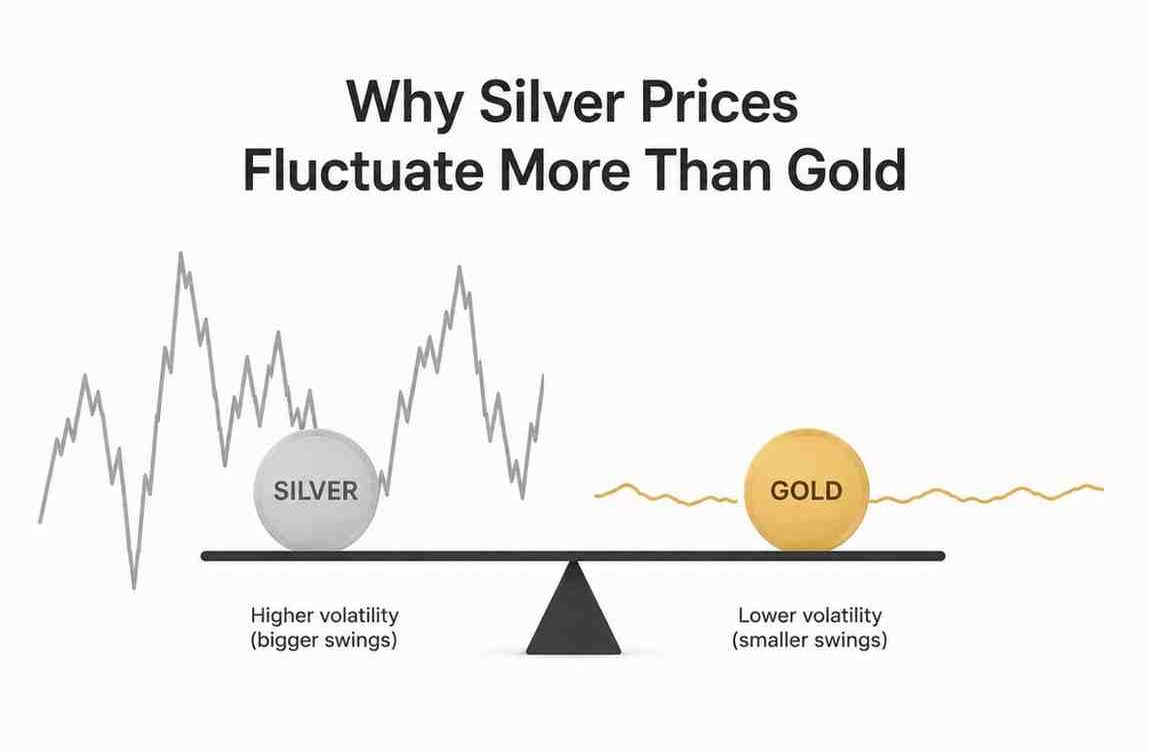
Why Silver Prices Fluctuate More Than Gold: Key Factors Explained
Why Silver Prices Fluctuate More Than Gold: Key Factors Explained
Silver and gold are both widely recognised as precious metals, but their price behaviour is very different. While gold is generally considered relatively stable during uncertain market conditions, silver is known for larger and faster price swings.
Thank you for reading this post, don't forget to subscribe!In commodity markets, silver prices often rise or fall more sharply than gold prices within short periods. This higher volatility is influenced by factors such as industrial demand, market size, liquidity, speculative trading activity, and supply constraints.
Understanding why silver is more volatile than gold can help investors make more informed decisions while evaluating precious metal investments.
What Does Volatility Mean in Commodity Markets?
Volatility refers to the extent and speed at which prices move over time. Higher volatility means an asset experiences larger price fluctuations within shorter durations.
In precious metals, volatility can be influenced by:
- Global economic conditions
- Inflation expectations
- Interest rate changes
- Currency movements
- Supply-demand imbalance
- Geopolitical developments
- Investor sentiment
Both gold and silver react to these factors, but silver tends to respond more aggressively.
Gold vs Silver: Understanding the Key Difference
Although both are precious metals, gold and silver serve different roles in global markets.
| Factor | Gold | Silver |
| Primary Role | Safe-haven asset | Industrial + precious metal |
| Market Size | Larger | Smaller |
| Volatility | Relatively lower | Relatively higher |
| Industrial Usage | Limited | Extensive |
| Investor Base | Central banks, long-term investors | Traders, retail investors, industries |
| Economic Sensitivity | Lower | Higher |
Gold is primarily viewed as a store of value and inflation hedge, whereas silver has both investment and industrial applications.
This dual role contributes significantly to silver’s higher volatility.
Smaller Market Size Leads to Bigger Price Swings
One of the main reasons silver prices fluctuate more than gold is the smaller size of the silver market.
Compared to gold:
- Silver has lower overall market value
- Trading volumes are relatively smaller
- Liquidity is comparatively lower
In smaller markets, even moderate buying or selling activity can cause significant price movements.
For example:
- Large institutional trades may sharply impact prices
- Sudden investor demand can trigger rapid rallies
- Panic selling may intensify corrections
Gold markets are deeper and more liquid, which often helps absorb large transactions more efficiently.
Industrial Demand Makes Silver More Sensitive
A major portion of silver demand comes from industrial sectors.
Silver is widely used in:
- Solar panels
- Electric vehicles
- Electronics
- Semiconductors
- Medical devices
- Batteries and renewable energy technologies
As industrial activity changes, silver demand may rise or fall accordingly.
During Economic Expansion
When manufacturing and industrial production increase:
- Silver demand may rise
- Prices may move higher rapidly
- Investor sentiment often improves
During Economic Slowdowns
When industrial activity weakens:
- Demand expectations may decline
- Prices can correct sharply
- Volatility may increase further
Gold is less dependent on industrial usage, making it comparatively more stable during economic cycles.
Speculative Trading Increases Volatility
Silver often attracts higher speculative participation than gold.
Several reasons contribute to this:
- Lower per-unit price compared to gold
- Easier accessibility for retail traders
- High participation in futures markets
- Availability of leveraged trading
In leveraged trading, traders control larger positions using smaller capital amounts. This can amplify gains as well as losses.
As a result:
- Rapid buying can accelerate rallies
- Stop-loss triggers may intensify declines
- Margin calls can increase market volatility
This speculative activity often causes silver prices to move faster than gold prices.
Supply Constraints Can Amplify Price Movements
Silver supply dynamics also contribute to volatility.
A large share of silver production globally comes as a byproduct of mining other metals such as:
- Copper
- Zinc
- Lead
- Gold
This means silver production may not increase immediately even if silver prices rise sharply.
For instance:
- Lower copper production may indirectly reduce silver supply
- Supply shortages can quickly impact prices
- Rising industrial demand may create tighter supply conditions
This limited supply flexibility can lead to stronger price swings.
Silver Has a Dual Identity
Silver behaves both as:
- A precious metal investment asset
- An industrial commodity
This hybrid nature creates competing market forces.
As a Precious Metal
Silver may benefit from:
- Inflation concerns
- Safe-haven demand
- Currency weakness
As an Industrial Metal
Silver may also react to:
- Manufacturing growth
- Industrial demand forecasts
- Renewable energy expansion
- Economic slowdowns
Because silver responds to both investment and industrial trends, its price behaviour is often less stable than gold.
Why Silver Reacts Faster to Economic News
Silver prices are highly sensitive to macroeconomic developments.
Important factors include:
- U.S. Federal Reserve policy decisions
- Inflation data
- Interest rate expectations
- Dollar strength
- Manufacturing PMI data
- Global industrial growth trends
Positive economic data may improve industrial demand expectations and support silver prices. However, weak economic indicators may lead to sharp declines.
Gold also reacts to economic events, but silver usually experiences larger percentage movements.
Silver Trading in India and MCX Influence
In India, silver trading activity on the Multi Commodity Exchange of India (MCX) also influences price volatility.
Indian silver prices are affected by:
- International silver prices
- Rupee-dollar exchange rates
- Import dependence
- Domestic demand from jewellery and industry
- Global economic conditions
Because India imports a substantial portion of its silver requirements, currency fluctuations can also impact domestic silver prices.
Is Silver Riskier Than Gold?
Silver is generally considered riskier than gold in the short term because of its higher volatility.
Potential Advantages of Silver
- Higher upside potential during commodity rallies
- Exposure to industrial growth sectors
- Growing renewable energy demand support
- Lower entry cost compared to gold
Risks Associated With Silver
- Sharper price corrections
- Greater short-term uncertainty
- Strong sensitivity to economic slowdowns
- Higher speculative risk
Investors should evaluate their:
- Risk tolerance
- Investment horizon
- Diversification strategy
before investing in silver-related assets.
Gold vs Silver: Which One May Suit Different Investors?
| Investor Preference | Gold | Silver |
| Stability-focused investors | More suitable | Less suitable |
| Aggressive growth seekers | Moderate potential | Higher potential |
| Inflation hedge | Strong | Moderate |
| Industrial growth exposure | Limited | High |
| Volatility tolerance | Lower required | Higher required |
The choice depends on individual financial goals and market outlook.
Conclusion
Silver prices fluctuate more than gold mainly because of the metal’s smaller market size, stronger industrial dependence, lower liquidity, speculative trading activity, and supply constraints.
While gold primarily acts as a defensive safe-haven asset, silver behaves as both a precious metal and an industrial commodity. This dual role makes silver significantly more sensitive to economic and market developments.
Although silver may offer higher growth potential during favourable market conditions, it also carries higher short-term risk. Investors should understand these dynamics carefully before adding silver exposure to their portfolios.
Related Blogs:
Why Gold and Silver ETFs Are Important for Portfolio Diversification in India
Digital Gold: Meaning, Features, and How It Works
How Rupee–Dollar Movement Affects Gold and Silver ETF Returns in India
Role of Gold and Silver ETFs During Market Crashes and Economic Uncertainty
What Happens to Gold ETFs If the Stock Market Crashes?
SIP vs Lump Sum Investment in Gold and Silver ETFs: Which Is Better?
Beginner’s Guide to Gold and Silver ETF Investment in India
Impact of Global Commodity Prices on Indian Gold and Silver ETFs
What are Closed-Ended Mutual Funds?
Lump Sum Investments – How Is It Different from an SIP?
What Are Open Ended Mutual Funds?
What is Reversal Trading?
What Is an Auction Market and How Does It Work?
Understanding Mutual Fund SIP Returns: How to Calculate and Maximize Your Earnings
SIP Calculator and Inflation: Understanding How Inflation Impacts Your Mutual Fund Returns
SIP vs. Lumpsum: What’s the Best Way to Invest in Mutual Funds for Retirement?
How to Use a SIP Calculator for Investment Planning?
Reach Your Financial Milestones Sooner with Step-Up SIPs
What is a SIP Calculator and How Can It Help?
SIP vs Lump Sum: Which Investment Strategy Is Better?
Why Smart Investors in India are Choosing Systematic Investment Plan (SIPs)
How to Start a SIP for Your Child’s Education or Future Goals
The Power of SIPs: Why Consistency Beats Timing the Market
Disclaimer: This blog post is intended for informational purposes only and should not be considered financial advice. The financial data presented is subject to change over time, and the securities mentioned are examples only and do not constitute investment recommendations. Always conduct thorough research and consult with a qualified financial advisor before making any investment decisions.
Why is silver more volatile than gold?
Silver is more volatile than gold because it has a smaller market size, lower liquidity, higher industrial demand dependence, and greater speculative trading activity.
Does industrial demand affect silver prices?
Yes. Silver is widely used in industries such as solar energy, electronics, electric vehicles, and semiconductors. Changes in industrial demand can significantly influence silver prices.
Is silver riskier than gold for investment?
Silver generally carries higher short-term price risk compared to gold due to larger price fluctuations. However, it may also provide higher return potential during commodity bull markets.
Why do silver prices react strongly to economic data?
Silver is linked closely to manufacturing and industrial activity. Economic indicators such as industrial production, inflation data, and interest rate decisions can strongly impact silver demand expectations.
How are silver prices determined in India?
Silver prices in India are influenced by:
• International silver prices
• MCX trading activity
• Rupee-dollar exchange rate
• Import costs
• Domestic demand and supply conditions
