

How Do RBI Liquidity Measures Impact Short-Term Market Volatility in India?
How Do RBI Liquidity Measures Impact Short-Term Market Volatility in India?
Short-term market volatility in India often spikes around RBI policy announcements. While interest rate changes grab headlines, liquidity measures—such as repo operations, CRR changes, OMOs, and VRR auctions—frequently play an equally important role in shaping near-term movements in equities, bonds, and money markets.
Thank you for reading this post, don't forget to subscribe!For retail and emerging investors, understanding how RBI liquidity actions influence market behaviour can help decode sudden rallies, sharp corrections, and shifts in sector leadership—without encouraging speculative decision-making.
This article explains what RBI liquidity measures are, how they transmit into financial markets, and why they impact short-term volatility, using real-world Indian market context.
Understanding Liquidity in the Indian Financial System
Liquidity refers to the availability of money in the banking and financial system that enables smooth lending, borrowing, and trading activity.
In India, the Reserve Bank of India (RBI) actively manages liquidity to:
-
Ensure orderly financial conditions
-
Support economic growth
-
Maintain inflation within the mandated target band
-
Preserve financial stability
Liquidity conditions directly influence:
-
Overnight interest rates
-
Bond yields
-
Bank funding costs
-
Risk appetite in equity markets
When liquidity is abundant, markets tend to be more stable and risk-friendly.
When liquidity tightens, volatility usually increases.
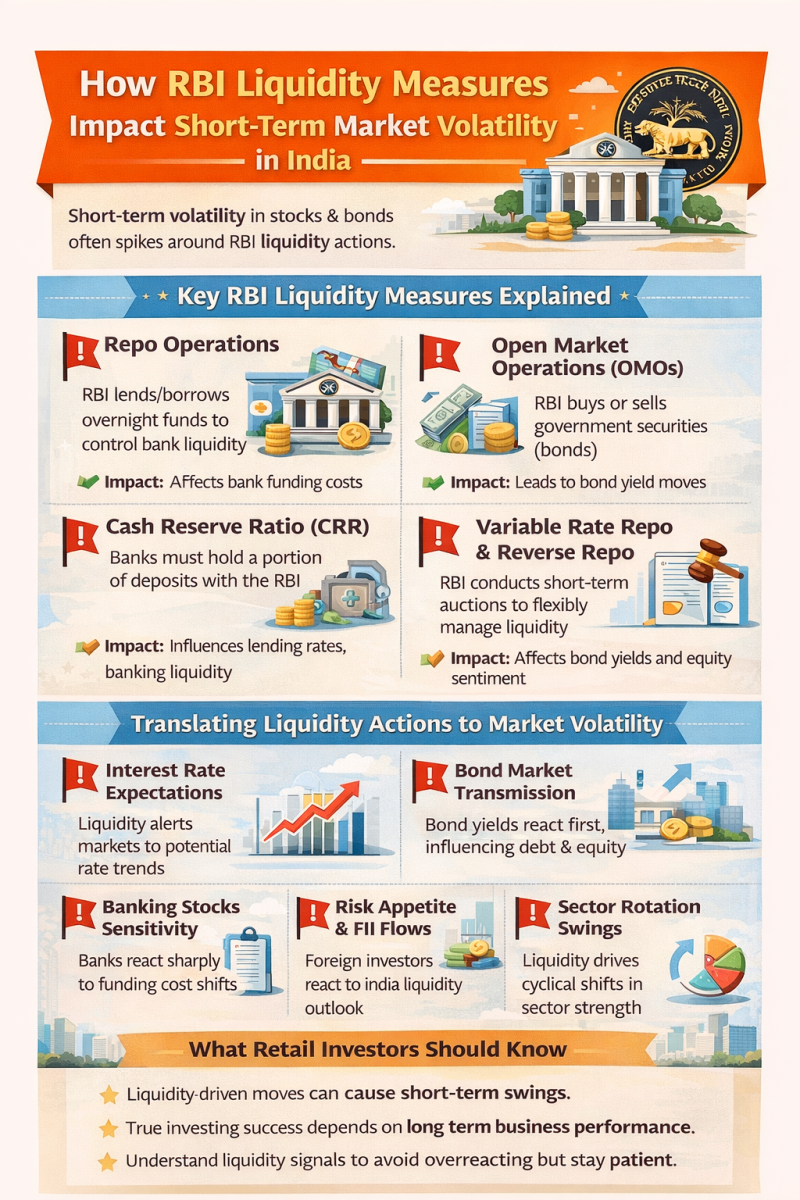
Key RBI Liquidity Measures Explained
1. Repo and Reverse Repo Operations
-
Repo rate: Rate at which banks borrow short-term funds from RBI
-
Reverse repo rate: Rate at which banks park excess funds with RBI
Impact on volatility:
-
Higher repo rates or tighter repo operations increase funding costs
-
Lower rates or ample liquidity injections calm markets
Official source: RBI Monetary Policy Framework
https://www.rbi.org.in/scripts/fs_overview.aspx?fn=2752
2. Open Market Operations (OMOs)
OMOs involve RBI buying or selling government securities.
-
RBI buys bonds → Injects liquidity
-
RBI sells bonds → Absorbs liquidity
Short-term market effect:
-
Bond purchases often compress yields and support rate-sensitive stocks
-
Bond sales may cause temporary stress in debt and equity markets
RBI OMO disclosures
https://www.rbi.org.in/Scripts/BS_PressReleaseDisplay.aspx
3. Cash Reserve Ratio (CRR)
CRR is the percentage of deposits banks must hold with RBI.
-
CRR cut → More lendable funds → Liquidity surge
-
CRR hike → Funds locked → Liquidity tightens
CRR changes are powerful and often lead to immediate market reactions, especially in banking stocks and money market instruments.
RBI CRR guidelines
https://www.rbi.org.in/Scripts/NotificationUser.aspx
4. Standing Deposit Facility (SDF) and MSF
-
SDF absorbs excess liquidity without collateral
-
Marginal Standing Facility (MSF) provides emergency funds at a penal rate
These tools help RBI fine-tune short-term liquidity, often stabilising overnight rates during volatile periods.
5. Variable Rate Repo (VRR) and Reverse Repo Auctions
VRR auctions allow RBI to manage liquidity dynamically based on market demand.
Why markets care:
-
Sudden changes in auction size or tenor signal RBI’s intent
-
Traders react quickly, impacting bond yields and equity sentiment
How RBI Liquidity Measures Translate into Market Volatility
1. Impact on Interest Rate Expectations
Liquidity signals influence expectations even without rate changes.
-
Tight liquidity = expectation of higher rates
-
Loose liquidity = expectation of policy support
Markets often react before actual rate changes occur.
2. Bond Market as the First Transmission Channel
Government bond yields react instantly to liquidity shifts.
-
Rising yields → pressure on equity valuations
-
Falling yields → support for rate-sensitive sectors
Bond market volatility often precedes equity volatility.
RBI Government Securities Market data
https://www.rbi.org.in/Commonman/English/Scripts/FAQs.aspx?SID=7
3. Effect on Banking and Financial Stocks
Banks are most sensitive to liquidity conditions.
-
Tight liquidity raises funding costs
-
Abundant liquidity improves margins and credit growth expectations
This explains why banking stocks often swing sharply on RBI announcements, even when policy rates remain unchanged.
4. Risk Appetite and FII Behaviour
Foreign Institutional Investors (FIIs) closely track:
-
RBI liquidity stance
-
INR stability
-
Bond yield differentials
Liquidity tightening can trigger short-term FII outflows, increasing volatility in frontline indices.
RBI data on capital flows
https://data.rbi.org.in/DBIE/#/dbie/home
5. Sector Rotation and Short-Term Swings
Liquidity-driven volatility often causes sectoral churn:
-
Tight liquidity → defensives outperform
-
Loose liquidity → cyclicals and financials gain traction
These movements are cyclical and temporary, not structural.
Why Short-Term Volatility Increases Around RBI Actions
-
Information asymmetry – Institutional players react faster
-
Position unwinding – Leverage reduces during tightening phases
-
Derivative market reactions – Options pricing amplifies moves
-
Algorithmic trading – Liquidity signals trigger automated trades
Retail investors often experience volatility without clear headlines, making understanding liquidity signals essential.
What Retail Investors Can Learn from RBI Liquidity Cycles
Rather than predicting market moves, investors can use liquidity cues to:
-
Avoid overreacting to short-term noise
-
Understand why markets behave irrationally in the near term
-
Focus on long-term fundamentals during volatile phases
Key insight:
Liquidity-driven volatility is usually temporary, while business fundamentals play out over years.
SEBI-Compliant Investor Perspective
As per SEBI investor protection guidelines, retail investors should:
-
Avoid trading solely based on policy expectations
-
Recognise that short-term volatility does not equal risk-free opportunity
-
Maintain asset allocation discipline
SEBI Investor Education resources
https://investor.sebi.gov.in/
Conclusion
RBI liquidity measures are powerful short-term market drivers, often influencing volatility more than headline rate decisions.
For Indian retail investors, understanding these mechanisms helps separate temporary market noise from long-term investment reality.
Instead of reacting to every RBI move, informed investors view liquidity cycles as part of the market ecosystem, not a signal to abandon disciplined investing.
Sources & References
-
Reserve Bank of India (RBI) – Monetary Policy Framework
Official explanation of RBI’s policy tools, liquidity management, and transmission mechanisms.
https://www.rbi.org.in/scripts/fs_overview.aspx?fn=2752 -
RBI – Liquidity Adjustment Facility (LAF) & Repo Operations
Details on repo, reverse repo, MSF, SDF, and liquidity absorption/injection tools.
https://www.rbi.org.in/commonman/English/Scripts/PressReleases.aspx?Id=3306 -
RBI – Open Market Operations (OMO) Disclosures
Regular press releases and data on government securities purchases and sales.
https://www.rbi.org.in/Scripts/BS_PressReleaseDisplay.aspx -
RBI – Cash Reserve Ratio (CRR) Notifications & FAQs
Regulatory guidelines and historical CRR changes impacting bank liquidity.
https://www.rbi.org.in/Scripts/NotificationUser.aspx -
RBI – Government Securities (G-Sec) Market Data
Yield curves, auction results, and bond market indicators reflecting liquidity conditions.
https://www.rbi.org.in/commonman/english/scripts/FAQs.aspx?SID=7 -
RBI – Weekly Statistical Supplement & Bulletin
Data on liquidity surplus/deficit, banking system liquidity, and capital flows.
https://www.rbi.org.in/Scripts/BS_ViewBulletin.aspx -
Securities and Exchange Board of India (SEBI) – Investor Education & Protection
Guidelines on investor awareness, risk disclosure, and market conduct.
https://investor.sebi.gov.in/ -
SEBI – Prohibition of Fraudulent and Unfair Trade Practices (PFUTP) Regulations
Regulatory framework relevant to market volatility and fair trading practices.
https://www.sebi.gov.in/legal/regulations/jun-2024/sebi-prohibition-of-fraudulent-and-unfair-trade-practices-relating-to-securities-market-regulations-2003-last-amended-on-june-28-2024-_84781.html -
Clearing Corporation of India Ltd. (CCIL) – Money Market & G-Sec Market Infrastructure
Institutional insights into short-term money market functioning in India.
https://www.ccilindia.com/
Related Blogs:
What Can Indian Investors Learn from Market Leaders That Have Survived Multiple RBI Rate Cycles?
The Role of RBI’s Monetary Policy in Stock Price Movements
How Do RBI, SEBI, and Government Policy Changes Create Long-Term Investment Opportunities?
The RBI’s Rate Cycle and Its Ripple Effect on Cement Sector Capex & Valuations
Impact of FIIs and DIIs on the Indian Stock Market
Understanding Market Sentiment: FII & DII Trends
Disclaimer: This blog post is intended for informational purposes only and should not be considered financial advice. The financial data presented is subject to change over time, and the securities mentioned are examples only and do not constitute investment recommendations. Always conduct thorough research and consult with a qualified financial advisor before making any investment decisions.
Does RBI liquidity tightening always lead to a market fall?
No. Liquidity tightening may cause short-term volatility, but markets can still rise if earnings growth and macro fundamentals remain strong.
Which markets react first to RBI liquidity measures?
Money markets and government bonds usually react first, followed by equities.
Are liquidity measures more important than repo rate changes?
In the short term, yes. Liquidity actions can impact markets even without a rate change.
How should retail investors respond to RBI-driven volatility?
By staying invested as per risk profile, avoiding impulsive decisions, and focusing on long-term goals.
Where can investors track RBI liquidity data?
RBI’s official website, policy statements, and weekly statistical supplements provide reliable data.
