

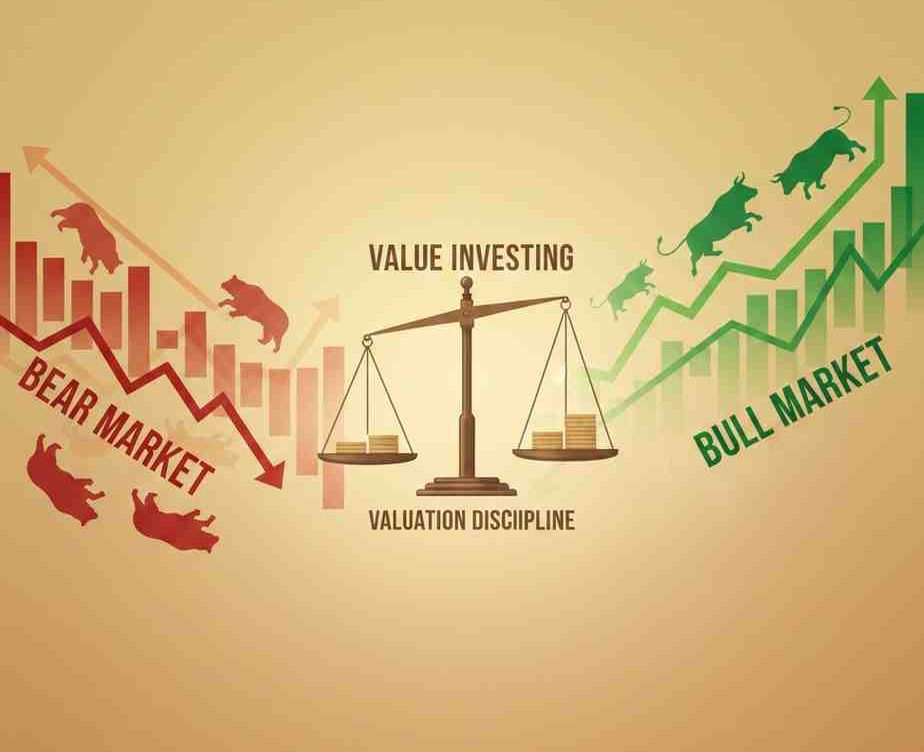
Is Value Investing More Effective in Bear Markets Than Bull Markets?
Is Value Investing More Effective in Bear Markets Than Bull Markets?
Market cycles shape investor behaviour. When markets fall sharply, conversations often turn toward safety, margin of safety, and fundamentals. When markets rise steadily, discussions shift to momentum and growth. In this context, a common question arises: Is value investing better in bear or bull markets?
Thank you for reading this post, don't forget to subscribe!For retail investors in India navigating volatile equity markets, understanding the effectiveness of value investing in different market cycles is essential. Rather than looking for a one-size-fits-all answer, it helps to examine how value strategies behave across bear and bull phases—and what that means for long-term portfolio decisions.
Understanding Value Investing
Value investing focuses on identifying companies that appear undervalued relative to their intrinsic worth. Investors typically assess financial ratios such as price-to-earnings (P/E), price-to-book (P/B), dividend yield, and free cash flow, alongside qualitative factors like management quality and competitive positioning.
The philosophy was popularised by Benjamin Graham and later practised by Warren Buffett, but the principles have found strong relevance in Indian markets as well. Domestic mutual fund categories such as value funds and contrarian funds are structured around similar ideas, though investors should evaluate scheme-related documents carefully before investing.
At its core, value investing is built on the assumption that markets can misprice stocks in the short term, but prices eventually reflect fundamentals over time.
What Happens to Value Investing in Bear Markets?
A bear market typically involves prolonged price declines, pessimism, and lower risk appetite. In such phases, investors often exit speculative or high-growth counters and move toward businesses with stable cash flows and reasonable valuations.
This is where value investing in bear markets gains attention.
- Margin of Safety Becomes Relevant
When stock prices fall broadly, fundamentally sound companies may also trade at discounted valuations. Value investors often seek this “margin of safety”—buying at a price lower than estimated intrinsic value.
During sharp corrections in Indian equities, such as those triggered by global macroeconomic concerns or liquidity tightening, quality companies with stable balance sheets may become available at relatively attractive valuations. However, not every low-priced stock represents value; some may reflect structural challenges.
- Downside Cushioning (Relative, Not Absolute)
Value investing during market downturns may offer relative downside protection compared to high-growth stocks that are priced for aggressive earnings expansion. When earnings expectations moderate, richly valued stocks can see sharper corrections.
That said, it is important to clarify that value stocks can also decline during bear markets. Equity investing carries market risk, and no strategy guarantees capital protection.
- Longer Holding Period Required
Bear markets test patience. Value investing typically requires a medium- to long-term horizon. Investors searching for quick rebounds may find the approach demanding, as undervalued stocks may take time to re-rate.
How Does Value Investing Perform in Bull Markets?
Bull markets are characterised by rising prices, strong sentiment, and higher liquidity. In such phases, investors often gravitate toward growth themes—technology, emerging sectors, and high earnings visibility.
This leads to the debate around value vs growth investing in bull markets.
- Growth Often Outpaces Value in Early Bull Phases
In the early stages of a bull market, growth stocks may outperform as investors reward earnings acceleration and expansion narratives. Valuations may stretch, supported by optimism and strong flows.
In such environments, value strategies may appear relatively subdued, especially if undervalued stocks belong to cyclical or traditional sectors.
- Rotation Within Market Cycles
However, bull markets are rarely linear. Sector rotation is common. As valuations in high-growth segments expand significantly, investors may rotate toward undervalued sectors.
This rotation highlights the effectiveness of value investing in different market cycles—not as a constant outperformer, but as a strategy that may gain traction when valuation gaps widen excessively.
- Valuation Discipline Matters
Even in rising markets, valuation discipline can support risk-adjusted decision-making. Paying significantly higher multiples without earnings support can increase volatility risk. Value-oriented investors may avoid such excesses, focusing instead on fundamentals.
Is Value Investing Better in Bear or Bull Markets?
The question—is value investing better in bear or bull markets—does not have a binary answer.
Instead, the effectiveness of value investing depends on:
- Entry valuation
- Sector composition
- Macroeconomic environment
- Earnings trajectory
- Investor time horizon
Historically, value strategies have often found stronger relative opportunities during periods of market stress, when mispricing tends to be more pronounced. However, during strong liquidity-driven bull markets, growth stocks may dominate performance.
For Indian retail investors, the key takeaway is not to choose between bear or bull markets, but to understand how different strategies behave across cycles.
Value Investing During Market Downturns
Here are practical considerations:
- Focus on Financial Strength
Companies with manageable debt, stable cash flows, and credible governance frameworks may be relatively resilient during downturns.
- Avoid Value Traps
A stock trading at low multiples is not automatically undervalued. Structural decline, poor capital allocation, or regulatory risks can justify low valuations.
- Align With Risk Profile
Investors should assess their financial goals, liquidity needs, and risk tolerance before allocating capital. Equity exposure should align with overall asset allocation strategy.
- Consider Diversification
Instead of concentrated bets, diversification across sectors and market capitalisations may help manage volatility. Investors may also explore professionally managed products after evaluating suitability and risk factors.
Value vs Growth: A False Dichotomy?
The framing of value vs growth investing in bull markets often suggests a choice between two opposing camps. In reality, many portfolios combine both approaches.
Modern factor-based investing frameworks allocate capital across value, growth, quality, and momentum factors. This blended approach acknowledges that no single style consistently outperforms across all environments.
For retail investors researching the effectiveness of value investing in different market cycles, it may be more practical to:
- Maintain a diversified core portfolio
- Add exposure to value-oriented opportunities during valuation corrections
- Rebalance periodically
This reduces the need to predict exact market turning points.
Behavioural Factors and Market Cycles
Investor psychology significantly influences style performance.
- In bear markets, fear dominates. Valuation discipline becomes central.
- In bull markets, optimism expands risk-taking behaviour.
Value investing, by design, attempts to counter emotional extremes—buying when pessimism suppresses prices and maintaining discipline when enthusiasm inflates valuations.
However, behavioural discipline is easier described than implemented. Staying invested in undervalued stocks during extended underperformance requires conviction and patience.
Long-Term Perspective for Retail Investors
For individuals building long-term wealth through equities, the focus should remain on:
- Asset allocation
- Periodic portfolio review
- Risk-adjusted return expectations
- Investment horizon alignment
Rather than asking whether value investing works only in bear markets, it may be more useful to evaluate:
- Does the strategy align with my financial goals?
- Can I stay invested through volatility?
- Am I diversifying adequately?
Indian equity markets have experienced multiple cycles influenced by domestic reforms, global liquidity, commodity trends, and geopolitical developments. No single style has remained dominant throughout.
Conclusion
Value investing in bear markets often attracts attention because falling prices create visible valuation gaps. During bull markets, growth narratives may lead performance discussions. But the effectiveness of value investing in different market cycles depends on broader economic conditions, earnings visibility, and investor behaviour.
For retail participants, the objective should not be to chase style trends, but to construct a disciplined, diversified portfolio aligned with long-term financial objectives.
Equity investments are subject to market risks. Investors are advised to read all scheme-related documents carefully and, where necessary, consult a registered financial advisor before making investment decisions.
Understanding market cycles can improve perspective. Aligning strategy with personal financial goals can improve consistency. And maintaining valuation discipline—across both bear and bull markets—can support structured decision-making over time.
References & Regulatory Sources
SEBI Guidelines for Listed Companies: https://www.sebi.gov.in
NSE Market Data: https://www.nseindia.com
BSE Market Data: https://www.bseindia.com
RBI Reports on Consumer Spending: https://www.rbi.org.in
Related Blogs:
Value Investing Strategies During Recessions and Market Slowdowns
What Drives Value Investing in Different Economic Cycles
Value Investing Opportunities in Cyclical Sectors
Growth Investing vs. Value Investing: Which Strategy Is Right for You?
Risk Management in Equity Investing: Protecting Your Portfolio
Value Investing as a Stock Market Investing Strategy in 2025
Long-Term Equity Investing: Beat the Market and Achieve Financial Freedom
Swing Trading: A Comprehensive Guide to Make Short-Term Gains
A Guide to Value Investing in 2025
Combining Sector Rotation with Other Investing Strategies
Beyond Buy and Hold: Elevating Returns with Sector Rotation
Common Pitfalls of Sector Rotation and How to Avoid Them
What is Sector Rotation and How Does it Work?
Sector rotation and the economic cycle: what is the connection?
How to Implement Diversification for a Profitable Portfolio
Build a Stronger Investment Portfolio Through Diversification
Diversification Strategies: Combining Commodities and Equities
Diversification Strategies: Why Spreading Your Risk Matters
How to Use Sector Rotation to Diversify Your Portfolio
Disclaimer: This blog post is intended for informational purposes only and should not be considered financial advice. The financial data presented is subject to change over time, and the securities mentioned are examples only and do not constitute investment recommendations. Always conduct thorough research and consult with a qualified financial advisor before making any investment decisions.
Is value investing better in bear or bull markets?
Value investing in bear markets may offer relatively attractive entry valuations when prices correct. However, in strong bull phases, growth stocks may outperform. The effectiveness of value investing in different market cycles depends on valuations, earnings outlook, and investor time horizon.
Why does value investing gain attention during market downturns?
During corrections, fundamentally stable companies may trade at discounted prices. This makes value investing during market downturns relevant for investors with a long-term perspective and adequate risk tolerance.
What is the difference between value vs growth investing in bull markets?
In bull markets, growth investing often focuses on companies with high earnings expansion potential, while value investing emphasises reasonable valuations and fundamentals. Performance may vary depending on liquidity, sentiment, and sector rotation.
Can value investing protect against losses in bear markets?
No equity strategy guarantees protection from losses. While value stocks may sometimes show relatively lower volatility compared to highly valued growth stocks, market risks remain.
How should Indian retail investors approach value investing?
Investors should align investments with their financial goals, risk appetite, and asset allocation strategy. Diversification and periodic portfolio review are important. Consulting a SEBI-registered investment advisor may be considered before making decisions.
