

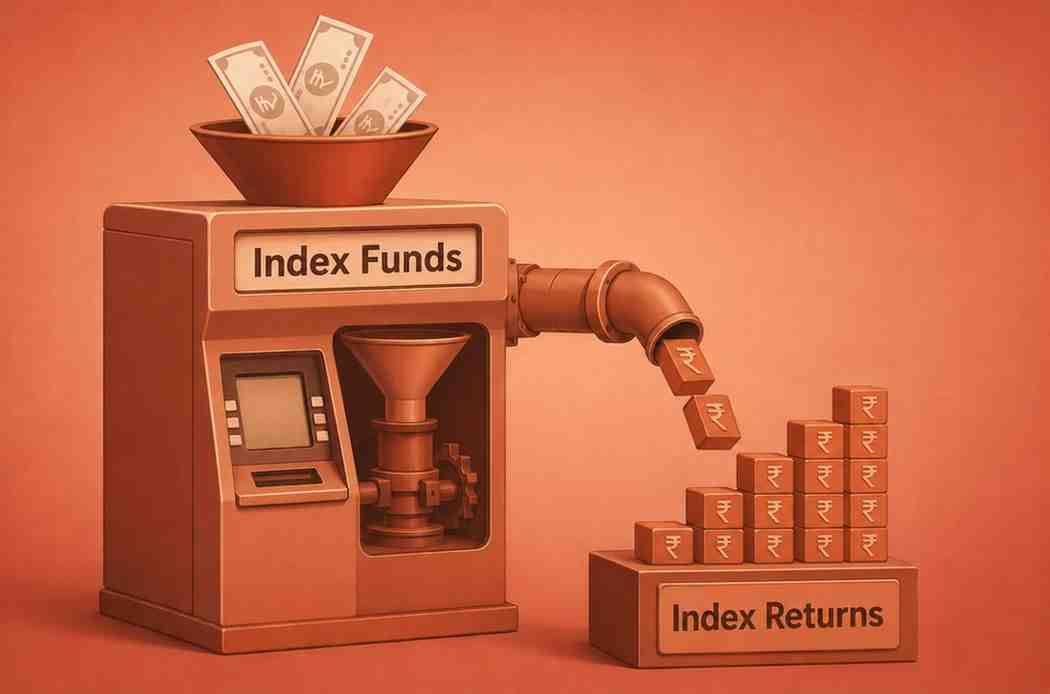
How Index Funds Work in Passive Investing
How Index Funds Work in Passive Investing
How index funds work: Index funds are mutual funds or ETFs that replicate a market index like the Nifty 50 or Sensex. Instead of actively selecting stocks, they passively track the index composition, offering diversified exposure at relatively lower costs. This makes them a commonly used option for long-term passive investing strategies in India.
Thank you for reading this post, don't forget to subscribe!If you’ve been exploring investment options in India, chances are you’ve come across terms like index funds, passive investing, and low-cost diversification. While these concepts are often discussed together, many investors still wonder: how index funds work and whether they are suitable for their financial goals.
This guide breaks down passive investing in a clear and practical way, especially for retail investors who are looking to build long-term wealth without actively tracking the markets.
What Are Index Funds?
Before understanding how they function, it’s important to answer a fundamental question: what are index funds?
An index fund is a type of mutual fund or exchange-traded fund (ETF) designed to replicate the performance of a specific market index. In India, popular benchmarks include the Nifty 50 and Sensex, which represent a basket of leading companies across sectors.
Instead of trying to outperform the market, index funds aim to match the returns of the index they track. This is why they are a core component of passive investing strategies.
For example, if an index fund tracks the Nifty 50, it will invest in the same 50 companies in roughly the same proportions as the index.
Passive Investing Explained
To understand how index funds work, you need to first grasp the idea of passive investing.
Passive investing is an approach where investors aim to mirror the performance of the market rather than beat it. Unlike active fund management—where fund managers select stocks based on research and predictions—passive investing follows a rule-based strategy.
Here’s what defines passive investing:
- Minimal buying and selling of securities
- Lower expense ratios compared to actively managed funds
- Long-term investment horizon
- Reduced dependence on fund manager decisions
The benefits of passive investing often appeal to investors who prefer a disciplined and cost-conscious approach.
How Index Funds Work in Practice
Now let’s get into the core question: how index funds work in real-world investing.
- Tracking a Market Index
Each index fund is linked to a specific benchmark index. The fund manager ensures that the portfolio closely replicates the index composition.
- Portfolio Replication
The fund invests in all (or a representative sample) of the securities in the index. This process is called replication.
- Performance Alignment
Since the goal is not to outperform, the fund’s returns will closely follow the index, subject to a small difference known as tracking error.
- Automatic Rebalancing
Whenever the underlying index changes (for example, when a company is added or removed), the index fund automatically adjusts its holdings.
- Cost Efficiency
Because there is limited active decision-making, index funds typically have lower management fees.
This structure makes index funds for beginners relatively straightforward compared to actively managed funds.
Benefits of Passive Investing Through Index Funds
The benefits of passive investing have made index funds increasingly relevant for Indian investors. Here are some key advantages:
- Diversification
By investing in an index fund, you gain exposure to a wide range of companies across sectors. This reduces the impact of poor performance from any single stock.
- Lower Costs
Expense ratios for index funds are generally lower than actively managed funds. Over time, this cost difference can influence net returns.
- Transparency
Since index funds follow a predefined benchmark, investors can easily understand where their money is invested.
- Reduced Bias
Passive investing removes emotional and behavioral biases that often affect active investment decisions.
- Suitable for Long-Term Goals
Index funds are often considered for long-term financial planning, such as retirement or wealth accumulation.
Index Funds for Beginners: What to Consider
If you’re exploring index funds for beginners, there are a few practical considerations to keep in mind:
Choose the Right Index
Different indices represent different segments of the market. For instance:
- Large-cap indices (like Nifty 50) offer exposure to established companies
- Broader indices include mid-cap and small-cap stocks
Check the Tracking Error
A lower tracking error indicates that the fund closely follows its benchmark.
Understand Expense Ratios
Even within index funds, expense ratios can vary. Comparing costs can help in making informed decisions.
Investment Mode
You can invest through:
- Lump sum investments
- Systematic Investment Plans (SIPs), which allow regular contributions
Time Horizon
Passive investing typically works better over longer time frames, as it aligns with overall market growth trends.
Comparison Table: Index Funds vs Active Funds
| Feature | Index Funds (Passive Investing) | Active Funds |
| Investment Strategy | Tracks a market index | Attempts to outperform the market |
| Fund Management Style | Passive | Active |
| Expense Ratio | Generally lower | Usually higher |
| Risk Level | Market-linked | Depends on fund manager decisions |
| Returns | Closely match index performance | May outperform or underperform |
| Transparency | High (index-based holdings) | Moderate |
| Suitability | Long-term, cost-conscious investors | Investors seeking alpha |
Common Misconceptions About Index Funds
While discussing passive investing explained, it’s also useful to address a few common misconceptions:
“Index Funds Guarantee Returns”
Index funds do not guarantee returns. Their performance depends on market movements.
“No Risk Involved”
Although diversified, index funds are still subject to market risk.
“Active Funds Always Perform Better”
Performance varies across market cycles. There are periods where passive strategies align closely with broader market returns.
Who Should Consider Index Funds?
Index funds may be relevant for:
- First-time investors seeking a simple entry into equity markets
- Individuals looking for low-cost investment options
- Investors with a long-term horizon
- Those who prefer a rules-based investment approach
However, suitability depends on individual financial goals, risk tolerance, and time horizon.
Conclusion
Understanding how index funds work is essential for anyone exploring passive investment strategies. By tracking a market index and minimizing active intervention, index funds offer a structured and cost-aware way to participate in market movements.
For investors in India, the growing availability of index funds and increasing awareness around passive investing explained have made these instruments a practical consideration. While they do not eliminate market risk, their simplicity, transparency, and alignment with long-term investing principles continue to attract retail participation.
Before making any investment decision, it is advisable to evaluate your financial objectives and consult a qualified financial professional if required.
Sources and Official References
Securities and Exchange Board of India
Association of Mutual Funds in India
NSE Indices Limited
BSE Limited
Related Blogs:
Passive Portfolio Management in India: Meaning, Strategies & How It Works
What Is Passive Investing? Index Funds and Long-Term Wealth Creation
When Should Investors Choose Active Over Passive Investing?
Active vs Passive Investing in India: Key Differences Explained
ETF Investing in India: A Beginner’s Guide to Passive Wealth
Why Value Investing Requires Patience Across Economic Cycles
Best Sectors for Value Investing During Economic Downturns
What Drives Value Investing in Different Economic Cycles
Growth Investing vs. Value Investing: Which Strategy Is Right for You?
Risk Management in Equity Investing: Protecting Your Portfolio
Value Investing as a Stock Market Investing Strategy in 2025
Long-Term Equity Investing: Beat the Market and Achieve Financial Freedom
Swing Trading: A Comprehensive Guide to Make Short-Term Gains
A Guide to Value Investing in 2025
Combining Sector Rotation with Other Investing Strategies
Beyond Buy and Hold: Elevating Returns with Sector Rotation
Common Pitfalls of Sector Rotation and How to Avoid Them
What is Sector Rotation and How Does it Work?
Sector rotation and the economic cycle: what is the connection?
How to Implement Diversification for a Profitable Portfolio
Build a Stronger Investment Portfolio Through Diversification
Diversification Strategies: Combining Commodities and Equities
Diversification Strategies: Why Spreading Your Risk Matters
How to Use Sector Rotation to Diversify Your Portfolio
Disclaimer: This blog post is intended for informational purposes only and should not be considered financial advice. The financial data presented is subject to change over time, and the securities mentioned are examples only and do not constitute investment recommendations. Always conduct thorough research and consult with a qualified financial advisor before making any investment decisions.
