

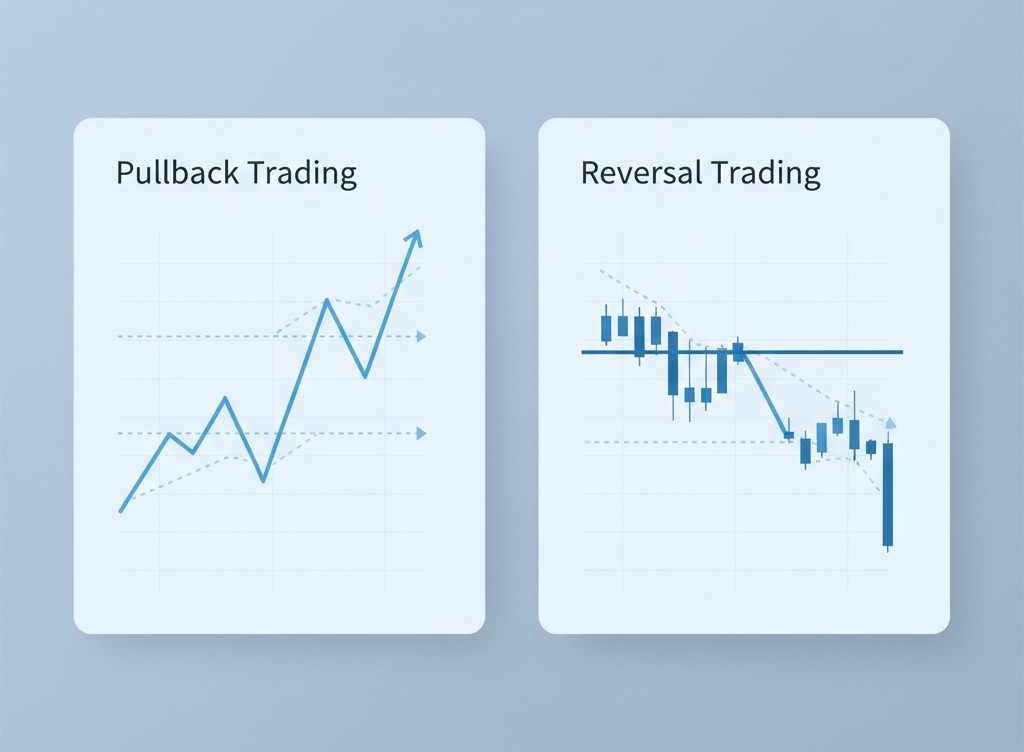
Reversal Trading vs Pullback Trading: Key Differences
Reversal Trading vs Pullback Trading: Key Differences
In active trading discussions, two terms frequently appear together — reversal and pullback. At first glance, they may seem similar because both involve price moving against the prevailing trend. However, the difference between reversal and pullback in trading is meaningful, especially for retail investors navigating volatile Indian markets.
Thank you for reading this post, don't forget to subscribe!If you have ever questioned whether a falling stock is merely consolidating or beginning a deeper decline, you are already thinking in terms of reversal trading vs pullback trading. Understanding this distinction helps traders assess risk, structure entries, and align their approach with market conditions.
This article explains the core differences, outlines each strategy, and highlights practical considerations for market participants. The discussion is educational in nature and should not be interpreted as investment advice.
Understanding Pullback Trading
Pullback Trading Strategy in Stock Market
A pullback trading strategy in the stock market involves entering a position in the direction of the prevailing trend after a temporary price correction.
For example:
- A stock is in a steady uptrend.
- Price declines due to short-term profit booking.
- The broader structure remains intact.
- A trader looks to enter during the dip, expecting the trend to resume.
In essence, pullback trading assumes that the dominant trend continues despite temporary fluctuations.
Key Characteristics of a Pullback
- Occurs within an established uptrend or downtrend
- Typically shallow relative to the overall move
- Often aligns with technical support or resistance levels
- Volume may contract during the corrective phase
In Indian markets, pullbacks are frequently observed near commonly tracked moving averages such as the 20-day or 50-day average in trending stocks.
Risk Considerations in Pullback Trading
Pullback trading generally involves placing a stop-loss below the recent swing low (in an uptrend) or above the recent swing high (in a downtrend). The expectation is that if the broader trend remains valid, price should not breach these levels decisively.
However, the risk lies in misidentifying a reversal as a pullback. If the larger trend is weakening, the corrective move may extend further than anticipated.
Understanding Reversal Trading
Reversal Trading Strategy Explained
A reversal trading strategy attempts to capture the beginning of a new trend after the previous one shows signs of exhaustion.
For instance:
- A stock has been in a prolonged downtrend.
- Selling pressure starts diminishing.
- A base formation develops.
- Price breaks above resistance with stronger participation.
- Traders enter, anticipating the start of an uptrend.
Unlike pullback trading, reversal trading assumes that the prior trend has ended and a structural shift is underway.
Key Characteristics of a Reversal
- Develops after an extended price movement
- Often associated with chart patterns such as double bottoms, double tops, or head-and-shoulders formations
- May show momentum divergence in indicators like RSI or MACD
- Volume expansion can support the change in direction
In Indian equities, reversals are sometimes observed around earnings announcements, macroeconomic developments, or sector-specific shifts.
Risk Considerations in Reversal Trading
Reversal trading often carries relatively higher uncertainty because traders are attempting to identify a turning point before the new trend becomes fully established. Stop-loss levels may be wider, and position sizing plays an important role in managing exposure.
False breakouts and failed reversals are common, particularly in range-bound or volatile market conditions.
Reversal Trading vs Pullback Trading: Core Differences
Understanding reversal trading vs pullback trading requires clarity on market structure and trader intent.
| Aspect | Pullback Trading | Reversal Trading |
| Trend Context | Within an existing trend | After a prior trend weakens |
| Assumption | Trend continuation | Trend change |
| Entry Logic | Buy/sell during temporary correction | Enter at potential turning point |
| Risk Profile | Generally lower if trend intact | Higher due to early trend entry |
| Confirmation | Support or resistance holds | Break of structure or pattern confirmation |
The primary difference between reversal and pullback in trading lies in whether the prevailing trend is expected to continue or change direction.
Market Psychology Behind Both Approaches
Price movements reflect collective behaviour.
During Pullbacks
- Short-term traders book profits.
- New participants wait for better entry levels.
- Institutional participants may accumulate near support.
- The broader trend resumes if demand remains strong.
During Reversals
- Sentiment gradually shifts.
- Market participants reassess valuations or fundamentals.
- Supply-demand dynamics change.
- A new directional bias begins to form.
Recognising these behavioural shifts can assist traders in distinguishing between temporary corrections and structural changes.
Technical Tools Used in Both Strategies
Although similar tools are used in both approaches, interpretation differs.
Moving Averages
- In pullbacks, price retraces toward a moving average and resumes the trend.
- In reversals, price may break and sustain above or below key moving averages.
Momentum Indicators
- During pullbacks, indicators cool off without breaking trend structure.
- During reversals, divergence may signal weakening momentum.
Support and Resistance
- Pullbacks respect established support or resistance levels.
- Reversals often involve decisive breaks of key levels.
It is important to understand that technical indicators provide probabilistic insights, not certainty.
Practical Considerations for Retail Investors
When evaluating reversal vs retracement trading concepts, investors should consider:
- Overall market trend (e.g., Nifty 50 direction)
- Sectoral momentum
- Liquidity and volatility
- Position sizing discipline
Overleveraging, particularly in derivatives such as futures and options, can amplify both gains and losses. A structured risk management plan remains central to both trading styles.
Additionally, trading strategies should align with broader financial goals and capital allocation plans. Active trading is distinct from long-term investing and may not be suitable for every market participant.
Common Mistakes to Avoid
- Treating every correction as a buying opportunity.
- Entering reversal trades without sufficient confirmation.
- Ignoring broader market conditions.
- Allowing emotional decision-making to override risk controls.
Clear definitions and disciplined execution reduce the likelihood of confusion between a pullback and a genuine reversal.
Regulatory and Risk Disclosure
This content is provided for educational purposes only and does not constitute investment advice, stock recommendations, or an offer to buy or sell securities. Market investments are subject to risks, including potential loss of capital. Past price movements, chart patterns, or technical indicators do not guarantee future performance. Investors should conduct independent research or consult a SEBI-registered investment adviser before making financial decisions.
Conclusion
The debate around reversal trading vs pullback trading is not about identifying a superior approach. Instead, it is about understanding market structure and aligning strategy with risk tolerance.
A pullback assumes continuation.
A reversal anticipates change.
Recognising the difference between reversal and pullback in trading allows traders to approach markets with greater clarity and structured decision-making. In dynamic environments such as Indian equity markets, disciplined execution and risk management remain foundational, regardless of the chosen strategy.
Related Blogs:
What is Reversal Trading?
Double Top and Double Bottom Patterns in Reversal Trading
Disclaimer: This blog post is intended for informational purposes only and should not be considered financial advice. The financial data presented is subject to change over time, and the securities mentioned are examples only and do not constitute investment recommendations. Always conduct thorough research and consult with a qualified financial advisor before making any investment decisions.
What is the main difference between reversal trading and pullback trading?
The key difference lies in trend expectation. Pullback trading assumes the existing trend will continue after a temporary correction, while reversal trading anticipates that the previous trend has ended and a new trend is beginning.
Is pullback trading less risky than reversal trading?
Pullback trading may involve relatively lower uncertainty because it aligns with the prevailing trend. Reversal trading can carry higher risk as it attempts to identify a turning point before a new trend is firmly established.
How can traders identify a potential reversal?
Traders often look for structural breaks, chart patterns (such as double bottoms or head-and-shoulders), momentum divergence, and increased volume to assess possible reversals. No indicator provides certainty.
What indicators are commonly used in pullback trading?
Moving averages, trendlines, Fibonacci retracement levels, and momentum indicators like RSI are frequently used to identify pullback opportunities within an existing trend.
Which strategy is suitable for beginners in the Indian stock market?
Suitability depends on risk tolerance, trading experience, and financial goals. Beginners are generally advised to prioritise risk management and consider seeking guidance from a SEBI-registered investment adviser before engaging in active trading.
