


Why Volume Trends Matter More Than Price Alone
Why Volume Trends Matter More Than Price Alone
When most investors look at stock charts, their attention naturally goes to price—whether a stock is rising, falling, or moving sideways. While price is important, it tells only half the story. The other half, often ignored by retail investors, is trading volume.
Thank you for reading this post, don't forget to subscribe!Volume reveals the strength, conviction, and sustainability behind price movements. A price move without volume can be misleading, but when price and volume move together, the signal becomes far more reliable. Understanding volume trends helps investors distinguish between genuine market interest and temporary or speculative moves.
What Is Trading Volume?
Trading volume refers to the number of shares traded during a specific period, such as a day, week, or month.
-
High volume = strong participation
-
Low volume = weak interest
Volume reflects how many buyers and sellers are actively involved in a stock at a given price.
Why Price Alone Can Be Misleading
A stock price can move for many reasons:
-
A single large trade
-
Low liquidity
-
Temporary news flow
-
Algorithmic trading
Without sufficient volume, price movements may lack conviction and reverse quickly.
For example:
-
A stock rising 5% on thin volume may not sustain gains
-
A stock rising 2% on heavy volume often signals stronger underlying demand
Why Volume Trends Matter More Than Price Alone
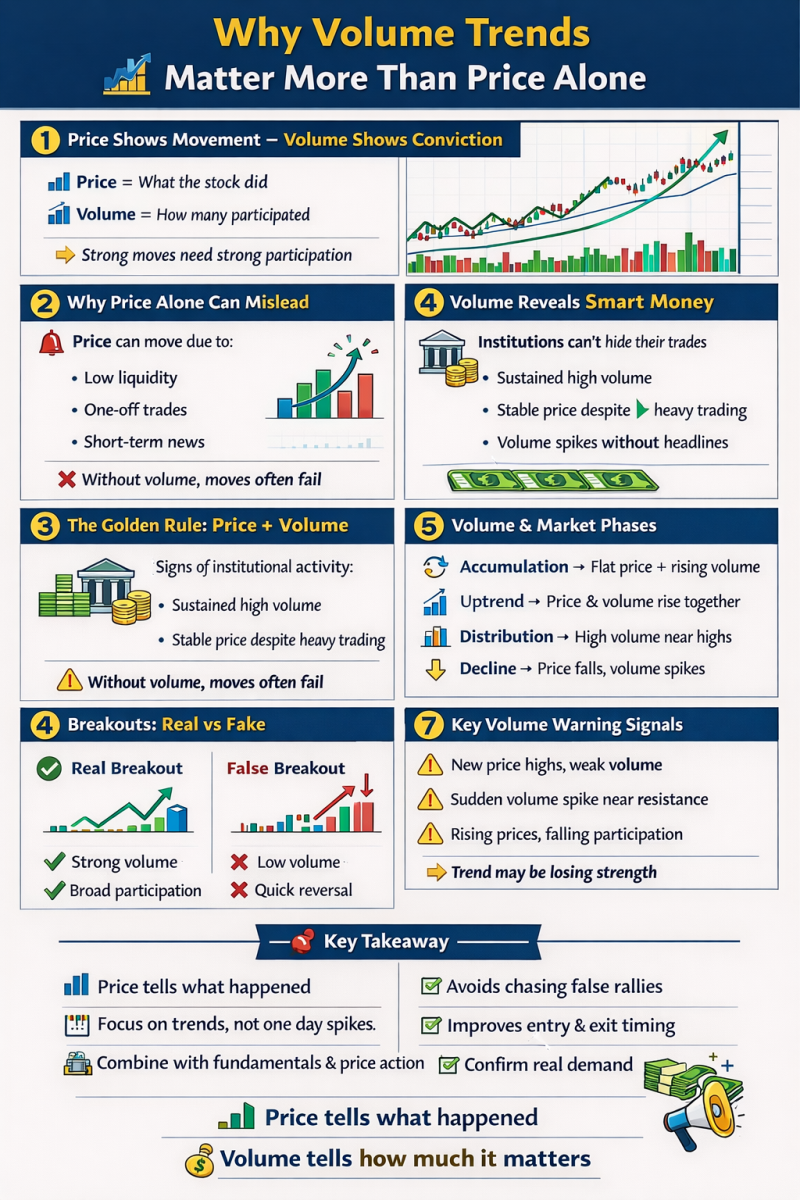
1. Volume Confirms Price Moves
One of the most important principles in market analysis is confirmation.
-
Rising prices + rising volume = healthy trend
-
Rising prices + falling volume = weak or speculative rally
-
Falling prices + rising volume = strong selling pressure
Volume confirms whether a price move is supported by broad market participation.
2. Volume Reveals Institutional Activity
Large institutions—mutual funds, FIIs, pension funds—cannot enter or exit stocks quietly. Their actions often show up first in volume.
Clues of institutional involvement include:
-
Sustained high volume over multiple sessions
-
Volume spikes without major news
-
Price stability despite heavy trading
Retail investors who track volume trends can often identify accumulation or distribution phases early.
3. Breakouts Without Volume Often Fail
A common mistake among retail investors is chasing price breakouts without checking volume.
-
A breakout on low volume often lacks follow-through
-
A breakout with strong volume indicates conviction
Volume helps distinguish false breakouts from genuine trend changes.
4. Volume Signals Trend Strength and Weakness
Price trends rarely reverse suddenly without warning. Volume often provides early signals.
Warning signs include:
-
Rising prices but declining volume
-
Price making new highs while volume fails to confirm
-
Sudden volume spikes near resistance levels
These divergences often precede trend exhaustion or reversals.
5. Volume Helps Identify Accumulation and Distribution
Markets move in phases:
-
Accumulation: Smart money builds positions quietly
-
Markup: Prices trend upward
-
Distribution: Large players sell into strength
-
Decline: Prices fall as demand dries up
Volume trends help identify where a stock sits in this cycle.
For example:
-
Flat prices with rising volume may indicate accumulation
-
Rising prices with heavy volume near highs may signal distribution
How Volume Enhances Technical and Fundamental Analysis
Volume + Technical Levels
When price approaches key levels such as:
-
Support
-
Resistance
-
Moving averages
Volume tells you whether the level is likely to hold or break.
-
High volume near support = stronger defense
-
High volume near resistance = potential breakout or exhaustion
Volume + Fundamental News
News-driven price moves gain credibility when supported by volume.
-
Positive results + strong volume = market approval
-
Good news + weak volume = skepticism
Markets vote through volume, not headlines alone.
Common Volume Patterns Every Investor Should Know
1. Volume Expansion
Increasing volume during price movement indicates growing participation and trend strength.
2. Volume Dry-Up
Falling volume during consolidation suggests a pause, not necessarily trend reversal.
3. Climax Volume
Extremely high volume after a long trend may signal exhaustion rather than continuation.
4. Volume Divergence
When price and volume move in opposite directions, caution is warranted.
Why Volume Is Especially Important for Retail Investors
Retail investors often:
-
Enter late
-
Chase price momentum
-
Ignore liquidity
Volume helps avoid these pitfalls by:
-
Highlighting genuine interest
-
Reducing false signals
-
Improving entry and exit timing
In illiquid stocks, price can be easily manipulated, making volume analysis even more critical.
Limitations of Volume Analysis
Volume is powerful, but not perfect.
Keep in mind:
-
Volume varies across exchanges and segments
-
Corporate actions can distort volume temporarily
-
Short-term volume spikes may be news-driven
Volume works best when combined with:
-
Price trends
-
Business fundamentals
-
Market context
How Retail Investors Can Use Volume Practically
1. Compare Volume to Its Own History
Always compare current volume with the stock’s average volume.
2. Focus on Trends, Not One-Day Spikes
Sustained volume trends matter more than single-session activity.
3. Use Volume to Manage Risk
Weak volume during rallies suggests tighter stop-losses and cautious sizing.
4. Combine with Business Quality
High volume does not compensate for poor fundamentals—but it helps with timing.
Volume vs Price: Which Leads?
Price tells where the stock is.
Volume tells how strongly the market believes in that price.
In many cases, volume leads and price follows.
Smart money often enters quietly with volume before price reacts meaningfully.
Final Thoughts
Price movements attract attention, but volume reveals truth. A stock’s price may change for many reasons, but volume shows whether the move has conviction, participation, and staying power.
For retail and emerging investors, understanding volume trends helps avoid false breakouts, identify early accumulation, and manage risk more effectively. When price and volume align, market signals become clearer and more reliable.
In investing, price tells you what happened—volume tells you how much it matters.
Related Blogs:
Fundamental Analysis vs Technical Analysis: Which Should You Follow?
Technical Indicators Every Beginner Investor Should Know
Unveiling the Power of Technical Analysis: Top Indicators to Enhance Your Trading Journey
Price Volume Breakout: A Proven Setup for Swing Traders
How to Identify Stock Accumulation and Distribution Using Volume & Price
VWAP (Volume Weighted Average Price): A Pro Tool for Intraday Traders
Disclaimer: This blog post is intended for informational purposes only and should not be considered financial advice. The financial data presented is subject to change over time, and the securities mentioned are examples only and do not constitute investment recommendations. Always conduct thorough research and consult with a qualified financial advisor before making any investment decisions.
