

Mainboard IPO vs SME IPO: Key Differences Explained
Mainboard IPO vs SME IPO: Key Differences Explained
India’s IPO market has expanded significantly in recent years, giving investors access to companies of different sizes and growth stages. Along with traditional IPOs of large companies, SME IPOs have also gained popularity among retail investors looking for early-stage growth opportunities.
Thank you for reading this post, don't forget to subscribe!However, many investors often get confused between a Mainboard IPO and an SME IPO. While both help companies raise capital from the public, they differ in terms of company size, regulations, liquidity, investment amount, risk levels, and investor participation.
Understanding these differences is important before applying for any IPO, especially since the risk-reward profile of SME IPOs can be very different from that of Mainboard IPOs.
What is a Mainboard IPO?
A Mainboard IPO refers to the public offering of shares by a relatively large and established company on major stock exchanges such as the National Stock Exchange (NSE) or Bombay Stock Exchange (BSE).
These companies generally have:
- Larger business operations
- Stronger financial history
- Higher revenue and profitability
- Wider institutional participation
Mainboard IPOs are regulated under stricter guidelines laid down by the Securities and Exchange Board of India (SEBI). They usually attract participation from retail investors, mutual funds, insurance companies, and foreign institutional investors.
Some well-known Mainboard IPOs in recent years include companies from sectors such as banking, fintech, automobiles, manufacturing, and consumer technology.
What is an SME IPO?
An SME IPO is an Initial Public Offering launched by a Small and Medium Enterprise (SME). These companies list their shares on dedicated SME platforms such as:
- NSE Emerge
- BSE SME
SME IPOs are designed to help smaller businesses raise capital for:
- Business expansion
- Working capital needs
- Debt repayment
- Capacity enhancement
- Technology upgrades
Compared to Mainboard companies, SMEs generally have:
- Smaller revenue base
- Limited operating history
- Lower market capitalisation
- Higher growth potential but higher business risk
SME IPOs often involve larger minimum investment amounts and comparatively lower liquidity after listing.
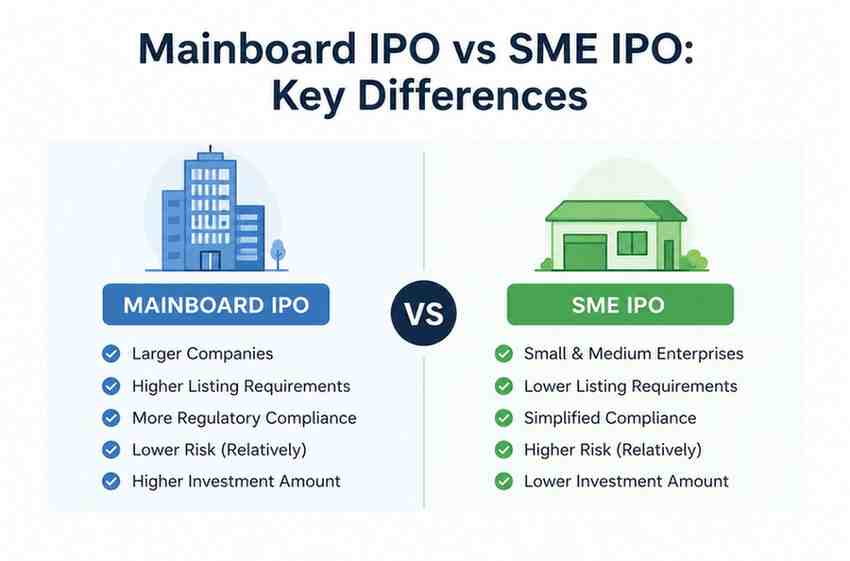
Mainboard IPO vs SME IPO: Major Differences
| Feature | Mainboard IPO | SME IPO |
| Company Size | Large and established companies | Small and medium-sized businesses |
| Listing Platform | NSE or BSE Mainboard | NSE Emerge or BSE SME |
| Capital Raised | Usually larger issue size | Smaller issue size |
| Regulatory Requirements | Stricter compliance norms | Comparatively relaxed norms |
| Liquidity | Higher liquidity | Lower liquidity |
| Minimum Investment | Lower investment requirement | Higher investment requirement |
| Investor Participation | Retail + Institutional investors | Mostly retail and HNI investors |
| Risk Level | Relatively lower | Comparatively higher |
| Lot Size | Smaller lot size | Larger lot size |
| Financial Disclosure | Extensive disclosures | Simpler disclosures |
Difference in Minimum Investment
One of the biggest differences between Mainboard and SME IPOs is the investment amount required.
Mainboard IPO
Mainboard IPOs are accessible to most retail investors because the minimum application amount is usually around ₹14,000–₹15,000 depending on the lot size and price band.
SME IPO
SME IPOs generally require a much higher minimum investment. In many cases, investors may need to invest over ₹1 lakh due to larger lot sizes.
This higher entry barrier limits participation mainly to:
- High-net-worth individuals (HNIs)
- Experienced investors
- Investors willing to take higher risk
Liquidity and Trading Differences
Liquidity refers to how easily investors can buy or sell shares in the market.
Mainboard IPOs
Mainboard stocks usually have:
- Higher trading volumes
- Wider investor participation
- Better price discovery
- Easier buying and selling
Investors can also sell shares in smaller quantities.
SME IPOs
SME stocks often have lower liquidity because:
- Trading volumes are smaller
- Investor participation is limited
- Lot sizes remain large even after listing
In some SME stocks, investors may find it difficult to exit quickly during volatile market conditions. SEBI also mandates market makers for SME IPOs to support liquidity for a specific period.
Regulatory and Compliance Differences
Mainboard IPO Regulations
Mainboard IPOs undergo detailed scrutiny by SEBI. Companies must comply with:
- Strict disclosure requirements
- Quarterly financial reporting
- Corporate governance norms
- Independent director requirements
The IPO approval process is usually longer because of extensive regulatory review.
SME IPO Regulations
SME IPOs follow comparatively simplified compliance requirements. Their documents are generally reviewed by stock exchanges, while SEBI plays a supervisory role.
SMEs may also have:
- Half-yearly financial reporting
- Reduced compliance burden
- Faster listing process
This simplified framework helps smaller companies access capital markets more efficiently.
Risk and Volatility Comparison
Mainboard IPO Risk Profile
Mainboard IPOs are generally considered relatively stable because the companies are often:
- Financially stronger
- Operationally established
- More transparent
- Widely tracked by analysts
However, market risks still exist, and listing gains are never guaranteed.
SME IPO Risk Profile
SME IPOs are considered higher risk due to:
- Smaller business scale
- Limited operating history
- Lower liquidity
- Higher price volatility
Some SME stocks witness sharp price movements after listing, both upward and downward. Market sentiment can also affect SME stocks more aggressively than established Mainboard companies.
Institutional Participation
Institutional investors play an important role in IPO markets.
Mainboard IPOs
Mainboard IPOs typically attract:
- Mutual funds
- Insurance companies
- Foreign institutional investors
- Domestic institutional investors
This participation often improves market confidence and liquidity.
SME IPOs
SME IPOs are usually dominated by:
- Retail investors
- HNIs
- Speculative investors seeking listing gains
Institutional participation in SME IPOs tends to be relatively limited compared to Mainboard IPOs.
Which IPO Type is better for Investors?
There is no single answer because both IPO categories serve different purposes.
Mainboard IPOs May Suit:
- Conservative investors
- Long-term investors
- Beginners in IPO investing
- Investors seeking relatively stable businesses
SME IPOs May Suit:
- High-risk investors
- Investors seeking early-stage growth opportunities
- Experienced market participants
- Investors comfortable with volatility and lower liquidity
Investors should evaluate:
- Company fundamentals
- Business model
- Financial health
- Valuation
- Industry outlook
- Risk appetite
before investing in any IPO.
Important Things to Check before Applying for Any IPO
Whether it is a Mainboard IPO or SME IPO, investors should carefully review:
- Draft Red Herring Prospectus (DRHP)
- Revenue and profit trends
- Debt levels
- Promoter background
- Purpose of issue
- Industry competition
- Valuation compared to peers
- Risk factors mentioned in the prospectus
Avoid applying to IPOs solely based on:
- Grey Market Premium (GMP)
- Social media hype
- Subscription figures
- Listing gain expectations
IPO performance can vary significantly depending on market conditions and company fundamentals.
Conclusion
Mainboard IPOs and SME IPOs both provide companies with access to public capital markets, but they differ significantly in scale, liquidity, investment size, regulations, and risk levels.
Mainboard IPOs are generally associated with larger, more established companies and comparatively lower volatility. SME IPOs, on the other hand, provide opportunities to invest in smaller, high-growth businesses, but they also come with higher risks and lower liquidity.
For investors, the right choice depends on:
- Financial goals
- Investment horizon
- Risk tolerance
- Market experience
A careful evaluation of company fundamentals and business quality is more important than chasing short-term listing gains.
Sources and Official References
Securities and Exchange Board of India
Association of Mutual Funds in India
NSE Indices Limited
BSE Limited
Related Blogs:
Passive Portfolio Management in India: Meaning, Strategies & How It Works
What Is Passive Investing? Index Funds and Long-Term Wealth Creation
When Should Investors Choose Active Over Passive Investing?
Active vs Passive Investing in India: Key Differences Explained
ETF Investing in India: A Beginner’s Guide to Passive Wealth
Why Value Investing Requires Patience Across Economic Cycles
Best Sectors for Value Investing During Economic Downturns
What Drives Value Investing in Different Economic Cycles
Growth Investing vs. Value Investing: Which Strategy Is Right for You?
Risk Management in Equity Investing: Protecting Your Portfolio
Value Investing as a Stock Market Investing Strategy in 2025
Long-Term Equity Investing: Beat the Market and Achieve Financial Freedom
Swing Trading: A Comprehensive Guide to Make Short-Term Gains
A Guide to Value Investing in 2025
Combining Sector Rotation with Other Investing Strategies
Beyond Buy and Hold: Elevating Returns with Sector Rotation
Common Pitfalls of Sector Rotation and How to Avoid Them
What is Sector Rotation and How Does it Work?
Sector rotation and the economic cycle: what is the connection?
How to Implement Diversification for a Profitable Portfolio
Build a Stronger Investment Portfolio Through Diversification
Diversification Strategies: Combining Commodities and Equities
Diversification Strategies: Why Spreading Your Risk Matters
How to Use Sector Rotation to Diversify Your Portfolio
Disclaimer: This blog post is intended for informational purposes only and should not be considered financial advice. The financial data presented is subject to change over time, and the securities mentioned are examples only and do not constitute investment recommendations. Always conduct thorough research and consult with a qualified financial advisor before making any investment decisions.
What is the main difference between Mainboard IPO and SME IPO?
The primary difference lies in company size and listing platform. Mainboard IPOs involve larger companies listed on NSE or BSE, while SME IPOs involve smaller businesses listed on NSE Emerge or BSE SME platforms.
Is SME IPO riskier than Mainboard IPO?
Yes, SME IPOs are generally considered riskier because of lower liquidity, smaller business size, and higher price volatility.
Why is the minimum investment higher in SME IPOs?
SME IPOs usually have larger lot sizes, which increases the minimum investment amount required for application.
Can SME companies shift to the Mainboard later?
Yes, successful SME-listed companies can migrate to the Mainboard exchange if they meet eligibility requirements and regulatory conditions.
Do institutional investors invest in SME IPOs?
Institutional participation in SME IPOs is generally lower compared to Mainboard IPOs, although some SME offerings may still attract institutional investors.
