

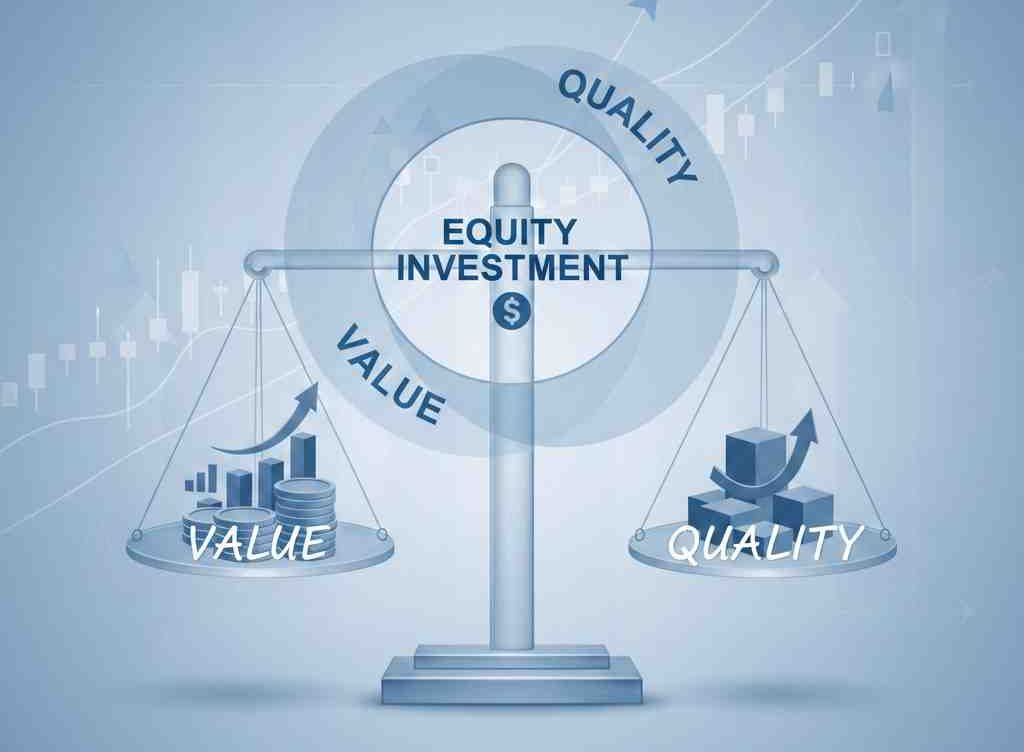
Combining Value and Quality Factors in Equity Investing
Combining Value and Quality Factors in Equity Investing
Equity investing is rarely about choosing one rigid style and sticking to it forever. Over time, many investors realise that relying on a single factor can leave portfolios exposed to blind spots. This is where combining value and quality factors in equity investing starts to make sense. Instead of asking whether value or quality is better, a more practical question is how the two can work together to create a balanced and resilient investment approach.
Thank you for reading this post, don't forget to subscribe!For Indian investors, especially those navigating volatile markets and shifting economic cycles, blending these factors can offer a more thoughtful framework for stock selection. Let’s explore how this approach works, why it matters, and how it aligns with long-term investing goals.
Understanding Value Investing in Simple Terms
Value investing focuses on identifying stocks that appear undervalued compared to their intrinsic worth. These are companies trading at lower valuations due to market pessimism, temporary challenges, or broader sector slowdowns. Common valuation metrics include price-to-earnings (P/E), price-to-book (P/B), and dividend yield.
In the Indian context, value investing often becomes relevant during periods of economic uncertainty, when entire sectors—such as banking, infrastructure, or manufacturing—may fall out of favour. The idea is not to buy cheap stocks blindly, but to assess whether the market has overreacted relative to the company’s fundamentals.
However, value investing on its own has limitations. Some stocks remain undervalued for long periods, while others may look cheap because their business prospects are genuinely weakening. This is where quality comes into the picture.
What Defines Quality in Equity Investing?
Quality investing looks beyond price and focuses on the strength of a company’s fundamentals. Quality stocks are typically characterised by consistent earnings, healthy return ratios, manageable debt levels, and strong governance practices. Metrics such as return on equity (ROE), return on capital employed (ROCE), cash flow stability, and debt-to-equity ratios are commonly used to assess quality.
For investors seeking quality stocks for long-term value investing, the emphasis is on businesses that can sustain performance across market cycles. In India, companies with durable brands, pricing power, and prudent capital allocation often fall into this category.
Yet, quality investing also comes with trade-offs. High-quality companies may trade at premium valuations, which can limit returns if growth expectations are already priced in. This highlights the relevance of combining value and quality factors rather than treating them as opposing strategies.
Factor Investing: Value vs Quality Explained
Factor investing involves selecting stocks based on specific characteristics—or factors—that have historically influenced returns. When discussing factor investing value vs quality, it’s important to note that these factors often perform differently across market phases.
Value tends to perform well during economic recoveries, when beaten-down stocks rebound. Quality, on the other hand, often provides stability during periods of uncertainty, as financially strong companies are better positioned to weather stress.
Instead of choosing one factor over the other, many investors now prefer a blended approach. By doing so, they aim to capture the upside potential of undervalued stocks while reducing the risk of investing in structurally weak businesses.
Why Combine Value and Quality Factors?
The logic behind a value and quality investing strategy is straightforward. Value helps investors avoid overpaying, while quality helps them avoid poor businesses. When combined, these factors act as a filter for more disciplined decision-making.
For example, consider a company trading at a low valuation multiple. On the surface, it may look attractive from a value perspective. However, if it also shows declining margins, high leverage, or inconsistent cash flows, it may not qualify on quality parameters. Conversely, a company with strong financials but stretched valuations may be excluded until pricing becomes more reasonable.
This approach encourages patience and selectivity, two traits that are particularly relevant for long-term investors in the Indian equity market.
Applying Value Investing with Quality Metrics
In practice, value investing with quality metrics involves screening stocks that meet both valuation and fundamental criteria. Investors may start with a universe of stocks trading below historical or sector averages and then apply quality filters to narrow down the list.
Some commonly used quality metrics include:
- Stable or improving ROE and ROCE over multiple years
- Consistent revenue and profit growth, adjusted for economic cycles
- Reasonable debt levels and strong interest coverage
- Positive operating cash flows
By layering these metrics, investors reduce the likelihood of investing in companies that are cheap for the wrong reasons. This process is particularly useful in sectors prone to cyclical downturns, where valuations can fluctuate significantly.
Relevance for Investors
Indian equity markets are influenced by domestic growth trends, global capital flows, policy changes, and sector-specific dynamics. In such an environment, relying solely on momentum or narrative-driven investing can increase volatility in portfolios.
Combining value and quality factors offers a more grounded framework. It aligns well with the preferences of investors who are focused on capital preservation alongside growth. This approach also fits the search intent of investors looking for clarity on how to balance risk and return without frequent portfolio churn.
Mutual funds and factor-based strategies in India are increasingly adopting blended models that incorporate both value and quality elements. While individual investors may not replicate these models exactly, understanding the underlying logic can help in evaluating fund strategies or making informed stock selections.
Common Misconceptions to Avoid
One common misconception is that combining factors guarantees smoother returns. While it may reduce certain risks, equity investing always involves uncertainty. Another assumption is that quality stocks never become undervalued. In reality, even strong businesses can face temporary setbacks that create value opportunities.
It’s also important to avoid overcomplicating the process. A balanced approach does not require tracking dozens of metrics. Instead, it calls for consistency in applying a few relevant indicators and reviewing them periodically.
Conclusion
Combining value and quality factors in equity investing reflects a shift towards more thoughtful portfolio construction. Rather than chasing trends or relying on a single style, investors acknowledge that both price and business strength matter.
For Indian investors with a long-term horizon, this blended approach can support more informed decision-making and better alignment with financial goals. By focusing on reasonably priced companies with sound fundamentals, investors position themselves to participate in growth while managing downside risks.
Ultimately, a value and quality investing strategy is less about market timing and more about discipline, patience, and clarity of purpose—qualities that remain relevant regardless of market conditions.
Related Blogs:
What Drives Value Investing in Different Economic Cycles
Growth Investing vs. Value Investing: Which Strategy Is Right for You?
Risk Management in Equity Investing: Protecting Your Portfolio
Value Investing as a Stock Market Investing Strategy in 2025
Long-Term Equity Investing: Beat the Market and Achieve Financial Freedom
Swing Trading: A Comprehensive Guide to Make Short-Term Gains
A Guide to Value Investing in 2025
Combining Sector Rotation with Other Investing Strategies
Beyond Buy and Hold: Elevating Returns with Sector Rotation
Common Pitfalls of Sector Rotation and How to Avoid Them
What is Sector Rotation and How Does it Work?
Sector rotation and the economic cycle: what is the connection?
How to Implement Diversification for a Profitable Portfolio
Build a Stronger Investment Portfolio Through Diversification
Diversification Strategies: Combining Commodities and Equities
Diversification Strategies: Why Spreading Your Risk Matters
How to Use Sector Rotation to Diversify Your Portfolio
Disclaimer: This blog post is intended for informational purposes only and should not be considered financial advice. The financial data presented is subject to change over time, and the securities mentioned are examples only and do not constitute investment recommendations. Always conduct thorough research and consult with a qualified financial advisor before making any investment decisions.
