

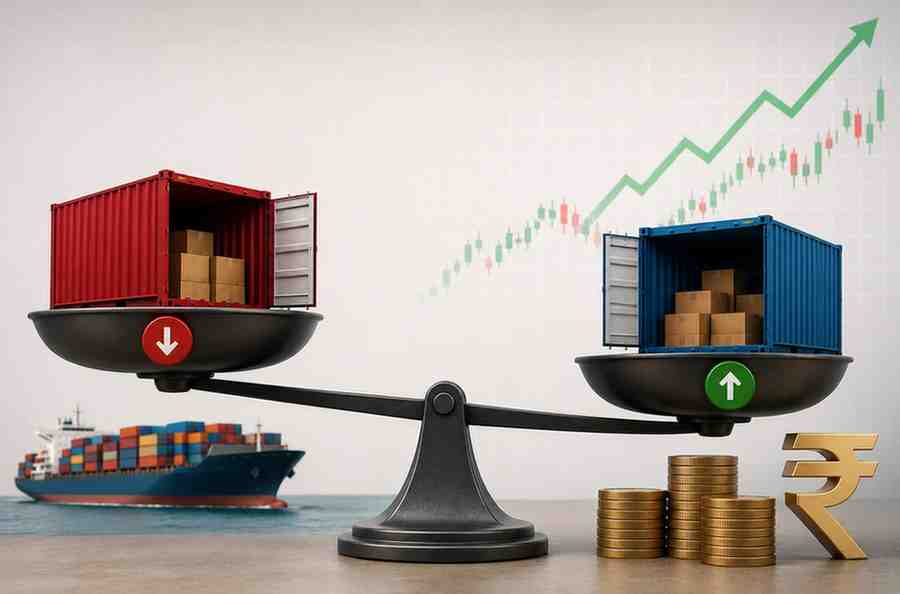
What Is the Trade Deficit and How Does It Impact Indian Stocks?
What Is the Trade Deficit and How Does It Impact Indian Stocks?
Global trade plays a significant role in shaping a country’s economic growth, currency strength, inflation trends, and financial markets. One of the most closely watched economic indicators is the trade deficit. While economists and policymakers frequently discuss it, many retail investors are unsure about its practical implications for the stock market.
Thank you for reading this post, don't forget to subscribe!Understanding the trade deficit meaning and its relationship with equity markets can help investors better interpret economic developments and assess their potential impact on different sectors. In India, where crude oil, electronics, and several industrial inputs are heavily imported, fluctuations in the trade deficit can influence corporate profitability, investor sentiment, and market performance.
This article explains what a trade deficit is, why it occurs, and how the impact of trade deficit on the Indian stock market can affect investors.
What Is a Trade Deficit?
A trade deficit occurs when the value of a country’s imports exceeds the value of its exports during a specific period.
In simple terms:
Trade Deficit = Total Imports – Total Exports
If India imports goods worth ₹100 and exports goods worth ₹80, the country records a trade deficit of ₹20.
The trade deficit meaning is often misunderstood as a negative economic indicator. However, a trade deficit is not necessarily harmful on its own. Its significance depends on factors such as the reasons behind higher imports, the country’s economic growth rate, foreign exchange reserves, and the sustainability of external financing.
For a developing economy like India, a moderate trade deficit may reflect rising domestic demand, industrial expansion, and infrastructure development. However, a persistently widening deficit can create economic challenges.
Why Does India Experience a Trade Deficit?
India has historically operated with a trade deficit due to its dependence on imported commodities and industrial inputs.
Some major contributors include:
Crude Oil Imports
India imports a substantial portion of its crude oil requirements. Rising global oil prices can significantly increase the country’s import bill.
Gold Imports
Gold remains a popular investment and consumption asset in India. Higher gold imports can widen the trade gap.
Electronics and Technology Products
India imports a considerable volume of semiconductors, electronic components, and advanced technology products.
Capital Goods and Industrial Inputs
Manufacturing industries often rely on imported machinery, equipment, and raw materials to support production.
These imports support economic activity but can also increase pressure on the country’s trade balance when export growth does not keep pace.
India Trade Deficit and Economy: Understanding the Connection
The relationship between the India trade deficit and economy is multifaceted.
A widening trade deficit can affect:
- Currency stability
- Inflation levels
- Interest rate expectations
- Foreign exchange reserves
- Economic growth outlook
When imports consistently exceed exports, demand for foreign currencies such as the US dollar increases. This can put downward pressure on the Indian rupee.
A weaker rupee often makes imports more expensive, potentially contributing to inflation. In response, policymakers may adopt measures aimed at stabilizing prices and maintaining macroeconomic balance.
As a result, investors closely monitor trade deficit data as part of broader economic analysis.
How Does a Trade Deficit Affect the Indian Stock Market?
The impact of trade deficit on the Indian stock market is usually indirect but can be meaningful, especially when deficits widen unexpectedly.
- Influence on Investor Sentiment
Financial markets react not only to current economic conditions but also to future expectations.
A rapidly expanding trade deficit may raise concerns about:
- Currency depreciation
- Higher inflation
- Slower economic growth
- Increased external vulnerabilities
These concerns can influence investor sentiment and contribute to market volatility.
- Impact on Foreign Institutional Investment
Foreign investors often evaluate macroeconomic indicators before allocating capital.
A sustained rise in the trade deficit could lead investors to reassess economic risks. If concerns intensify, foreign capital inflows may slow, affecting liquidity and market performance.
However, the actual market impact depends on several other factors, including economic growth, corporate earnings, and global market conditions.
- Effect on Interest Rate Expectations
Trade deficits can indirectly influence inflation trends through higher import costs.
If inflationary pressures increase, market participants may anticipate tighter monetary policy from the Reserve Bank of India.
Changes in interest rate expectations often affect equity valuations, particularly in sectors that are sensitive to borrowing costs.
How Trade Deficit affects Share Prices across Sectors
One of the most important considerations for investors is understanding how trade deficit affects share prices in different industries.
Sectors That May Face Challenges
Oil Marketing Companies
Higher crude oil import costs can affect margins depending on pricing dynamics and government policies.
Aviation Companies
Airlines are particularly sensitive to fuel costs. Rising oil prices combined with currency depreciation may increase operating expenses.
Automobile Manufacturers
Companies dependent on imported components may experience higher production costs if the rupee weakens.
Consumer Electronics
Imported raw materials and finished products can become more expensive, affecting profitability.
Sectors That May Benefit
Information Technology
A weaker rupee can increase the value of overseas earnings when converted into Indian currency.
Pharmaceutical Exporters
Companies generating significant export revenue may benefit from currency depreciation.
Specialty Chemical Exporters
Export-oriented businesses may gain pricing advantages in global markets.
Therefore, while a widening trade deficit can create challenges for some industries, it may support earnings growth in others.
Trade Deficit vs Current Account Deficit: What Investors should know
A common source of confusion is the difference between the trade deficit and the current account deficit.
Understanding the current account deficit vs trade deficit distinction is important for investors evaluating economic health.
| Parameter | Trade Deficit | Current Account Deficit |
| Definition | Excess of imports over exports of goods | Broader measure covering trade, services, income, and transfers |
| Scope | Goods trade only | Comprehensive external transactions |
| Indicator Type | Narrow economic measure | Broader macroeconomic indicator |
| Investor Relevance | Impacts currency and trade flows | Reflects overall external sector health |
In essence, the trade deficit forms one component of the current account deficit.
A country can have a trade deficit but still maintain a manageable current account position if service exports and other inflows remain strong.
India’s substantial software and IT service exports often help offset part of the merchandise trade deficit.
What should Retail Investors Monitor?
Rather than reacting to a single monthly trade deficit number, investors may consider tracking broader trends.
Key indicators include:
- Monthly trade deficit data
- Export growth rates
- Import growth rates
- Crude oil prices
- Rupee exchange rate
- Inflation trends
- Current account deficit levels
- Corporate earnings guidance
Evaluating these indicators together can provide a more balanced view of economic conditions and market risks.
Does a Higher Trade Deficit Always Mean Stocks Will Fall?
Not necessarily.
The stock market responds to a combination of factors, including:
- Economic growth expectations
- Corporate earnings
- Interest rates
- Liquidity conditions
- Global market trends
- Government policies
A higher trade deficit may create concerns if it reflects economic imbalances. However, if imports are rising due to strong domestic demand, industrial expansion, or infrastructure investment, markets may interpret the data differently.
Conclusion
Understanding the trade deficit meaning is essential for investors seeking to interpret economic developments and their potential influence on financial markets. While a trade deficit indicates that imports exceed exports, its impact depends largely on the underlying economic environment.
The relationship between the India trade deficit and economy extends beyond trade flows and can influence currency movements, inflation, foreign investment, and market sentiment. Consequently, the impact of trade deficit on the Indian stock market is often felt through these broader economic channels rather than through direct effects alone.
For investors, understanding how trade deficit affects share prices across different sectors can provide valuable perspective when evaluating market trends. Rather than viewing trade deficit data in isolation, it is more useful to consider it alongside corporate earnings, monetary policy, currency movements, and overall economic growth.
Sources and Official References
Securities and Exchange Board of India
Association of Mutual Funds in India
NSE Indices Limited
BSE Limited
Related Blogs:
How India’s Exports and Imports Influence the Stock Market
Portfolio Management Services (PMS) in India: Meaning, Benefits, Risks, and Who Should Invest
Passive Portfolio Management in India: Meaning, Strategies & How It Works
What Is Passive Investing? Index Funds and Long-Term Wealth Creation
When Should Investors Choose Active Over Passive Investing?
Active vs Passive Investing in India: Key Differences Explained
ETF Investing in India: A Beginner’s Guide to Passive Wealth
Why Value Investing Requires Patience Across Economic Cycles
Best Sectors for Value Investing During Economic Downturns
What Drives Value Investing in Different Economic Cycles
Growth Investing vs. Value Investing: Which Strategy Is Right for You?
Risk Management in Equity Investing: Protecting Your Portfolio
Value Investing as a Stock Market Investing Strategy in 2025
Long-Term Equity Investing: Beat the Market and Achieve Financial Freedom
Swing Trading: A Comprehensive Guide to Make Short-Term Gains
A Guide to Value Investing in 2025
Combining Sector Rotation with Other Investing Strategies
Beyond Buy and Hold: Elevating Returns with Sector Rotation
Common Pitfalls of Sector Rotation and How to Avoid Them
What is Sector Rotation and How Does it Work?
Sector rotation and the economic cycle: what is the connection?
How to Implement Diversification for a Profitable Portfolio
Build a Stronger Investment Portfolio Through Diversification
Diversification Strategies: Combining Commodities and Equities
Diversification Strategies: Why Spreading Your Risk Matters
How to Use Sector Rotation to Diversify Your Portfolio
Disclaimer: This blog post is intended for informational purposes only and should not be considered financial advice. The financial data presented is subject to change over time, and the securities mentioned are examples only and do not constitute investment recommendations. Always conduct thorough research and consult with a qualified financial advisor before making any investment decisions.
Is a trade deficit always bad for the Indian economy?
Not necessarily. A trade deficit simply means that a country's imports exceed its exports. In a growing economy like India, a moderate trade deficit may reflect strong consumer demand, infrastructure development, and industrial expansion. However, a persistently high trade deficit can increase pressure on the rupee, inflation, and external balances.
How does a trade deficit impact the Indian stock market?
The impact of a trade deficit on the Indian stock market is usually indirect. A widening trade deficit can influence currency movements, inflation expectations, and foreign investment flows. These factors may affect investor sentiment and corporate earnings, leading to sector-specific movements in stock prices.
Which sectors are most affected by a higher trade deficit in India?
Import-dependent sectors such as oil & gas, aviation, automobiles, and consumer electronics may face higher costs if the rupee weakens due to a widening trade deficit. On the other hand, export-oriented sectors like information technology, pharmaceuticals, and specialty chemicals may benefit from stronger export competitiveness.
What is the difference between a trade deficit and a current account deficit?
A trade deficit measures the difference between a country's imports and exports of goods. A current account deficit is a broader economic indicator that includes trade in goods and services, investment income, and transfer payments. Therefore, the trade deficit is one component of the current account deficit.
How can investors track India's trade deficit?
Investors can monitor monthly trade data released by the Ministry of Commerce and Industry, Government of India, along with indicators such as export growth, import growth, crude oil prices, rupee exchange rates, inflation, and current account data. Tracking these metrics together provides a more comprehensive view of the economy and market conditions.
Can a trade deficit affect the value of the Indian rupee?
Yes. When imports exceed exports, demand for foreign currencies such as the US dollar tends to increase. This can put pressure on the Indian rupee. A weaker rupee may increase import costs but can also benefit export-oriented companies by making their products and services more competitive globally.
