

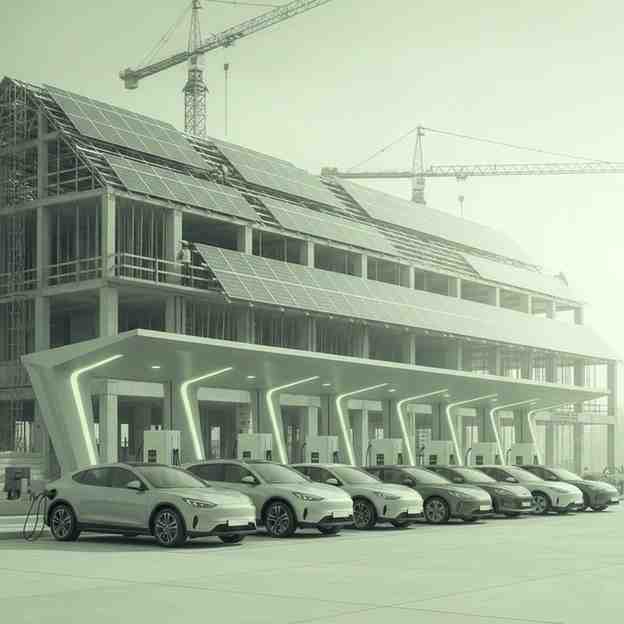
EV Charging Market Expansion and Its Impact on Green Energy Investment in India
EV Charging Market Expansion and Its Impact on Green Energy Investment in India
India’s electric mobility journey has been steadily picking up pace over the last few years. Backed by strong policy support, rising consumer acceptance, and a clear push toward sustainable transportation, electric vehicles are no longer a niche trend. At the heart of this transformation lies a crucial enabler—the rapid expansion of the EV charging market.
Thank you for reading this post, don't forget to subscribe!As electric vehicle charging infrastructure in India scales up, it does much more than simply power EVs. It is reshaping investment flows into renewable energy, influencing business models, and even changing how investors evaluate EV stocks and green energy stocks in India. For investors, policymakers, and market watchers, understanding this intersection between EV charging market growth and clean energy investment has become increasingly important.
This blog explores how India’s EV charging ecosystem is evolving, what is driving its growth, and why it matters for renewable energy investments and EV‑related stocks.
1. Understanding the Current Landscape of EV Charging in India
The expansion of electric vehicle charging infrastructure in India has accelerated significantly, driven by central and state‑level EV policies, private sector participation, and rising EV adoption. While the early phase of EV penetration was concentrated in major metros, Tier‑2 and Tier‑3 cities are now emerging as strong growth centres due to improved awareness and the availability of affordable EV models.
Today, India’s EV charging ecosystem includes multiple formats:
- Public charging stations (PCS) in urban and semi‑urban areas
- Captive charging networks set up by fleet operators and logistics companies
- Home and workplace chargers for private EV owners
- Fast‑charging corridors on highways enabling long‑distance travel
Each segment plays a distinct role, but together they support a more reliable and scalable charging network. Standardisation of charging equipment, interoperability norms, and digital payment systems has further accelerated installations.
This evolving ecosystem has also caught the attention of the equity markets. Companies involved in charging infrastructure, power distribution, and renewable integration are increasingly being tracked as EV charging stocks or ancillary EV plays by long‑term investors.
2. Key Drivers Behind EV Charging Market Growth in India
The surge in electric vehicle adoption—especially in two‑wheelers and three‑wheelers—has emerged as one of the strongest catalysts for EV charging market growth in India. As confidence in EV technology improves, demand for accessible and dependable charging networks rises alongside it.
Some of the major growth drivers include:
a) Government Policies and Incentives
Schemes such as FAME II, production‑linked incentives (PLI) for advanced battery manufacturing, and state‑specific EV policies have laid a strong foundation for charging infrastructure development. Reduced GST on EV chargers and favourable electricity tariff regulations across multiple states have further improved project viability.
From an investment perspective, consistent policy support improves long‑term visibility for companies operating in this space—an important factor when evaluating EV infrastructure stocks and renewable energy stocks in India.
b) Increasing Private Sector Participation
Oil marketing companies, power utilities, EV manufacturers, and tech startups are actively investing in charging networks. Business models range from pay‑per‑use and subscription‑based charging to premium fast‑charging and integrated charging‑plus‑parking services.
This diversification not only improves consumer choice but also strengthens revenue visibility for listed players. As a result, market participants are closely tracking companies involved in charging deployment as part of broader EV stock investment themes.
c) Rising Corporate Adoption of EV Fleets
E‑commerce firms, logistics providers, ride‑hailing platforms, and delivery services are rapidly electrifying their fleets to control fuel costs and meet sustainability targets. This shift has driven demand for captive charging stations, boosting charger installations across warehouses and urban hubs.
For investors, this trend reinforces the long‑term demand outlook for charging infrastructure companies and renewable power suppliers linked to EV operations.
3. How EV Charging Expansion Influences the Renewable Energy Sector
One of the most important outcomes of EV charging market expansion is its impact on green energy investments in India. As charging demand rises—particularly from fast and ultra‑fast chargers—it creates fresh opportunities for renewable energy integration.
a) Growing Demand for Clean Power
Charging network operators are increasingly looking for stable, cost‑effective electricity sources, and renewable energy fits this requirement well. Many charging hubs are now integrating:
- Solar rooftop installations
- Open‑access solar and wind power purchase agreements
- Battery energy storage systems for peak‑load management
This trend benefits renewable developers and power producers, strengthening the investment case for green energy stocks aligned with EV growth.
b) Supporting India’s Sustainability Goals
India’s long‑term energy strategy focuses on reducing fossil fuel dependence while expanding renewable capacity. The synergy between EV charging and renewable energy helps achieve both objectives simultaneously. As more charging stations adopt green power, grid stress reduces and clean mobility becomes truly sustainable.
This alignment enhances investor confidence in companies operating at the intersection of EV infrastructure and renewable energy.
c) Investment Opportunities Across the Value Chain
EV charging expansion is not limited to electricity demand alone. It drives investments across a broader technology and infrastructure value chain, including:
- Energy‑efficient charging equipment
- Smart meters and load‑balancing solutions
- IoT‑based charger management platforms
- Solar‑plus‑storage charging systems
For investors tracking EV stocks in India, this opens multiple avenues—from power generation and equipment manufacturers to software‑driven charging solutions.
4. India EV Charging Industry Trends Shaping Investment Decisions
Several emerging trends in the India EV charging industry are shaping long‑term investment strategies and influencing how markets value EV‑linked companies.
a) Shift Toward Smart Charging
Smart charging enables better load management, lower operating costs, and grid optimisation—especially in urban areas with high peak demand. This strengthens integration between EV charging networks and renewable energy grids, supporting sustainable growth.
b) Expansion of Highway Fast‑Charging Networks
With intercity EV travel becoming more viable, fast‑charging stations are expanding along national and state highways. Many of these stations combine grid power with solar or hybrid energy systems, improving reliability and cost efficiency.
c) Co‑location of Solar Projects With Charging Hubs
Commercial charging hubs at malls, logistics parks, and office complexes are increasingly paired with rooftop solar installations. This model reduces operating costs and creates an attractive long‑term proposition for investors analysing EV charging and solar energy stocks.
d) Focus on Battery Storage Integration
Battery energy storage helps smooth demand fluctuations and improves the economics of fast‑charging stations. The combination of storage, renewables, and charging infrastructure is emerging as a key theme for long‑term clean energy investment.
5. What This Means for Investors and Industry Stakeholders
The EV charging market expansion is not just an infrastructure story—it is shaping capital allocation across the energy and mobility ecosystem.
For Investors:
There is growing interest in companies that integrate EV charging with renewable energy solutions. Long‑term demand visibility is pushing investors to track both established utilities and emerging EV‑focused players as part of diversified EV stock portfolios.
For Policymakers:
Clear frameworks around electricity tariffs, renewable procurement, and digital infrastructure can accelerate the rollout of smart, sustainable charging networks.
For Businesses:
Commercial properties such as malls, hotels, fuel stations, and office parks can monetise charging infrastructure while reducing power costs through renewable tie‑ups.
6. Future Outlook: Toward an Integrated EV–Energy Ecosystem
As India’s EV ecosystem matures, the relationship between charging infrastructure and clean energy investment will deepen further. Charging expansion drives renewable capacity additions, while affordable green power improves EV operating economics.
The next phase of growth is likely to focus on:
- Wider adoption of smart grid technologies
- Increased investment in solar‑plus‑storage charging stations
- Faster rollout of public fast‑charging infrastructure
- Stronger public‑private partnerships across energy and mobility
Conclusion
The evolution of India’s EV charging market signals a broader shift in the country’s energy and transportation landscape. As charging networks expand, they are directly influencing renewable energy investments and shaping the outlook for EV stocks and green energy stocks in India.
For readers seeking insights into EV charging market growth in India, its impact on green energy investments, or the investment potential of EV‑linked companies, understanding this convergence is essential. The ongoing transition offers meaningful long‑term opportunities for stakeholders across infrastructure, energy, and capital markets—helping India move toward a cleaner, more energy‑secure future.
Related Blogs:
EV Charging Stations and Grid Modernisation: Implications for Renewable Energy Stocks
Electric Vehicles and Solar Power: Emerging Opportunities for Indian Renewable Stocks
From EV Batteries to Wind Farms: Understanding the Interconnected Growth of Clean Energy Sectors
India’s Semiconductor Sovereignty: The Geopolitical Tailwinds Boosting Domestic Stock
How the ‘Semicon India’ Program is Supercharging Semiconductor Stocks
India’s Sunrise Sector: Why Semiconductor Stocks are a Must-Watch for Smart Investors
Best Semiconductor Stocks in India
Why Does Your Portfolio Need Semiconductor Stocks?
Best Semiconductor Stocks in India 2024
Top 5 Semiconductor Stocks in India
Top 5 Cybersecurity Stocks in India
Best Cybersecurity Stocks in India
Can Defense Stocks Shield Your Investment Portfolio?
Investing in the Convergence of Cybersecurity and Data Centers
Top Trends in Data Centers and Cybersecurity in India: What Investors Need to Know
Riding the Wave: How Technology is Reshaping Stock Trading
Best Green Energy Stocks in India 2025
Renewable Energy Stocks: A Core Component of a Robust 2025 Portfolio
How Investors Can Capitalize on the Growth of Renewable Energy in India
India’s Renewable Energy Revolution: Beyond Solar and Wind
Best Green Energy Stocks in India
Best Solar Stocks in India
Best Green Hydrogen Stocks in India
Top 5 Solar Energy Stocks in India
Best Green Hydrogen Stocks in India
Top 5 Green Energy Stocks in India
Disclaimer: This blog post is intended for informational purposes only and should not be considered financial advice. The financial data presented is subject to change over time, and the securities mentioned are examples only and do not constitute investment recommendations. Always conduct thorough research and consult with a qualified financial advisor before making any investment decisions.
